QFlow begins a community test pilot with Quantum Hacettepe
The scoped pilot will test how visual circuits, synchronized code, simulation evidence, and guided learning hold up in real student-team workflows.
3 chapters
8 focused sections
6 sources
primary links
3 signals
operating context
1,046 words
reviewed analysis
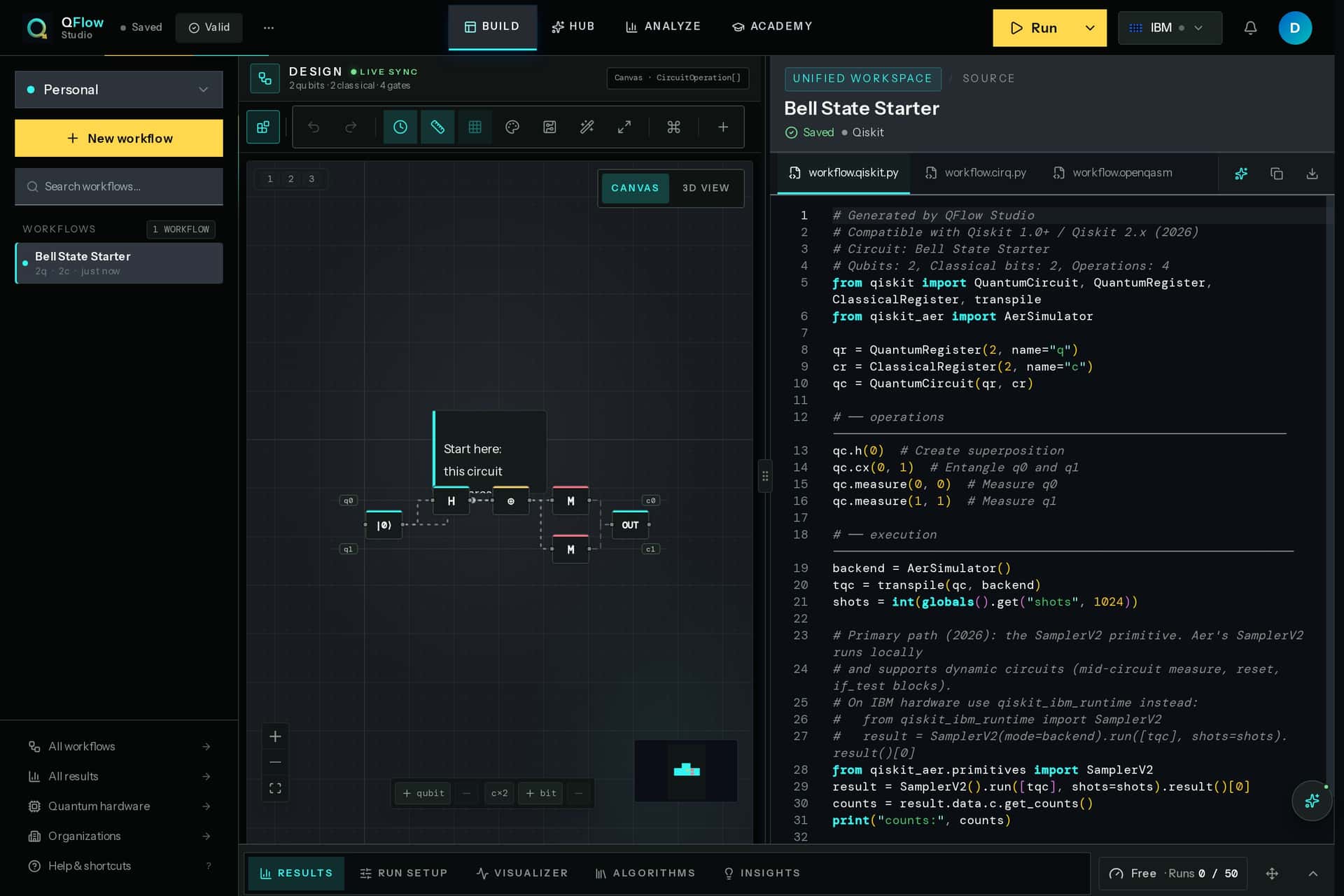
QFlow Studio and the Quantum Hacettepe student community are beginning a bounded test pilot focused on the daily work between learning a circuit and producing reviewable run evidence. Participants will work with the same circuit in Design and Code, use simulation before scarce hardware, and record concrete feedback on clarity, reliability, and team handoff. The pilot is a community product-testing program; it does not represent a university-wide deployment or institutional endorsement by Hacettepe University.
1
shared workflow record
Design, generated code, run state, and review evidence stay attached
3
pilot loops
learn, build, and review turn participant activity into usable feedback
0
automatic approvals
people approve edits and runs before QFlow applies or executes them
Why this pilot exists
Quantum programming education often breaks at the handoff between explanation and practice. A learner sees a gate diagram in one place, writes code in another, starts a simulator somewhere else, and then has to reconstruct what happened when a teammate asks for the result. The test pilot is designed to examine that gap in ordinary student-team use, not in a polished one-off demonstration.
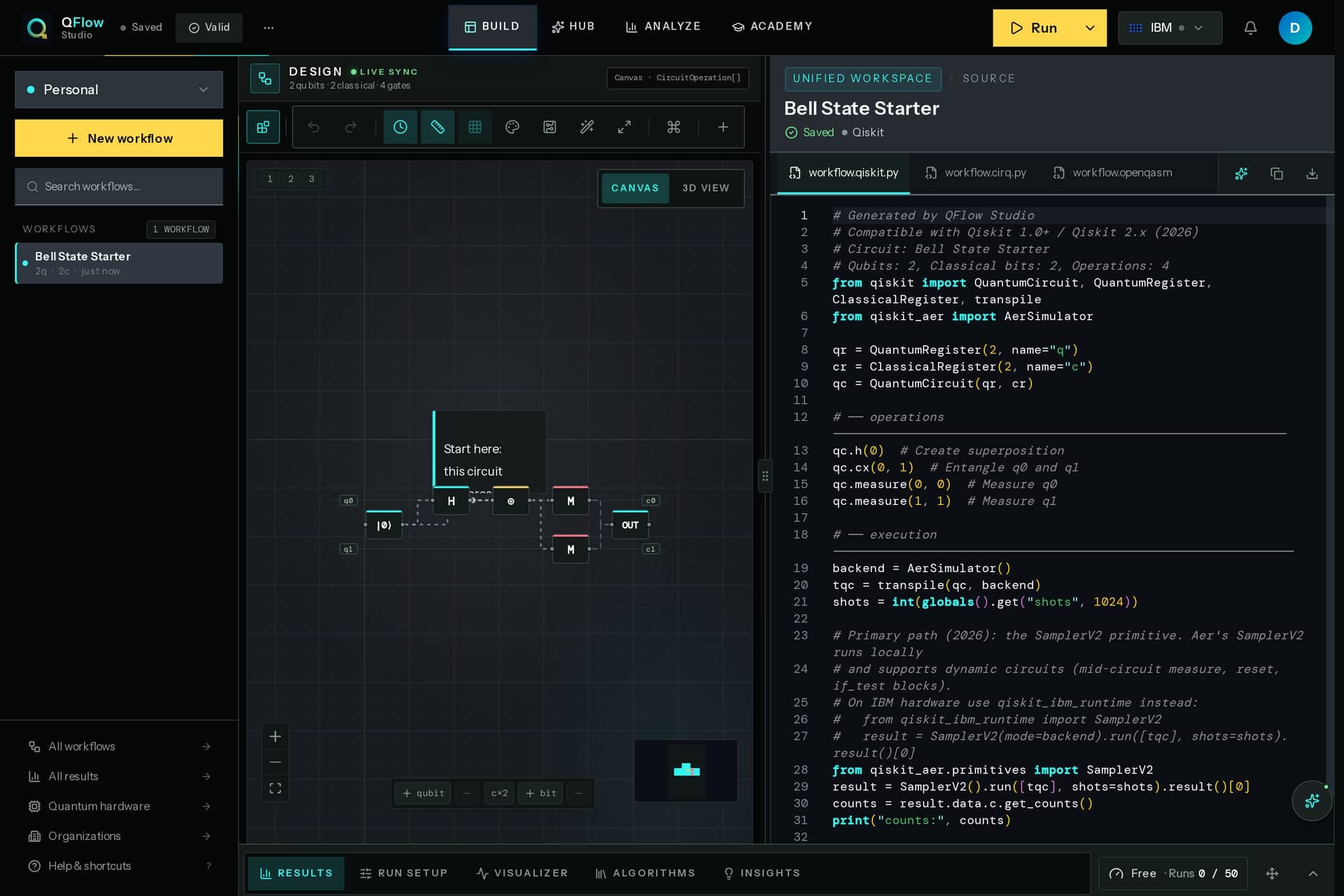
Quantum Hacettepe gives the pilot a useful community setting: students from different disciplines are learning, organizing workshops, and turning theory into practical work. QFlow contributes a bounded product environment in which a visual circuit and its generated code describe the same operation list. The central question is simple: can a participant understand the circuit, change it confidently, run it safely, and explain the result without losing context between tools?
What participants will actually test
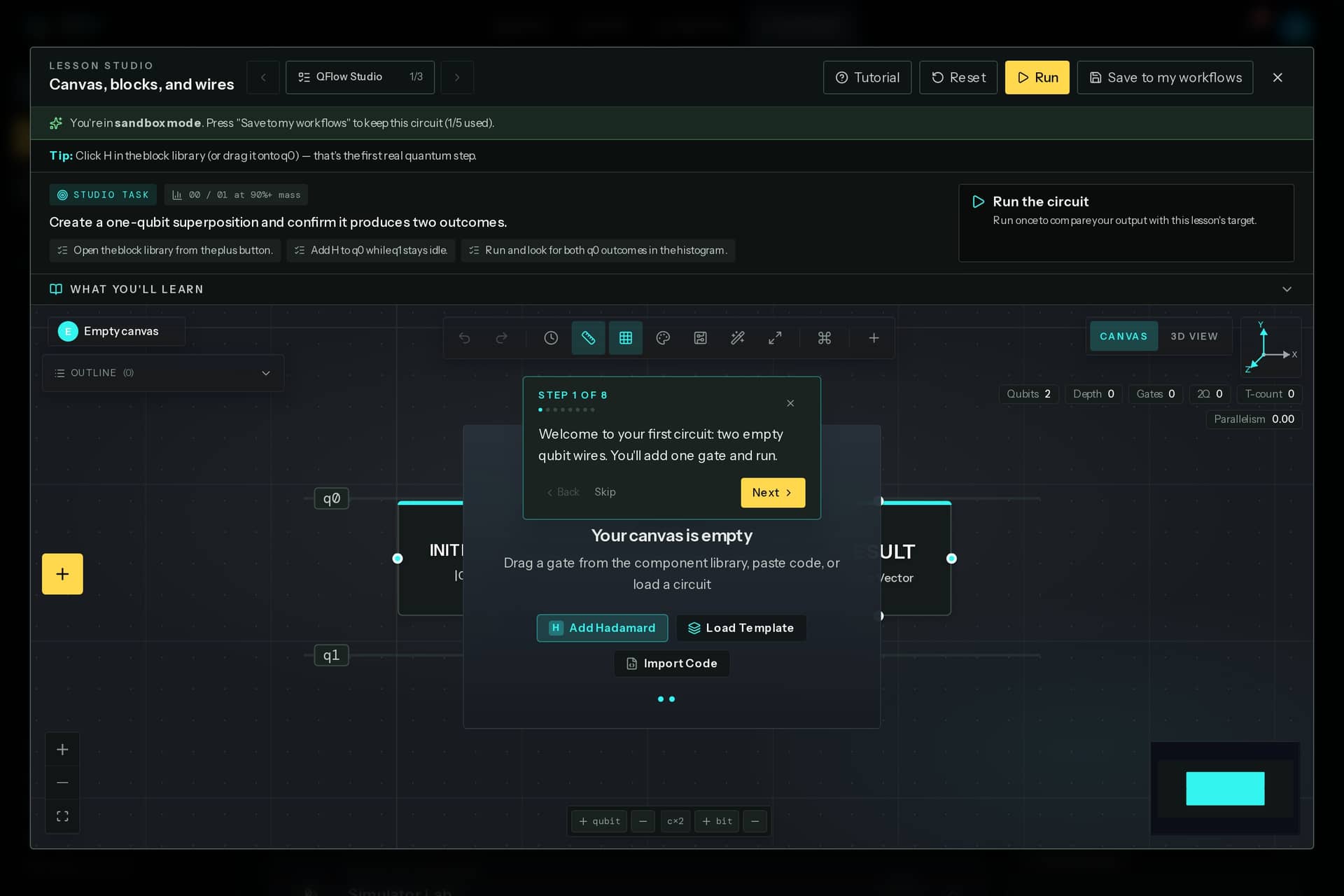
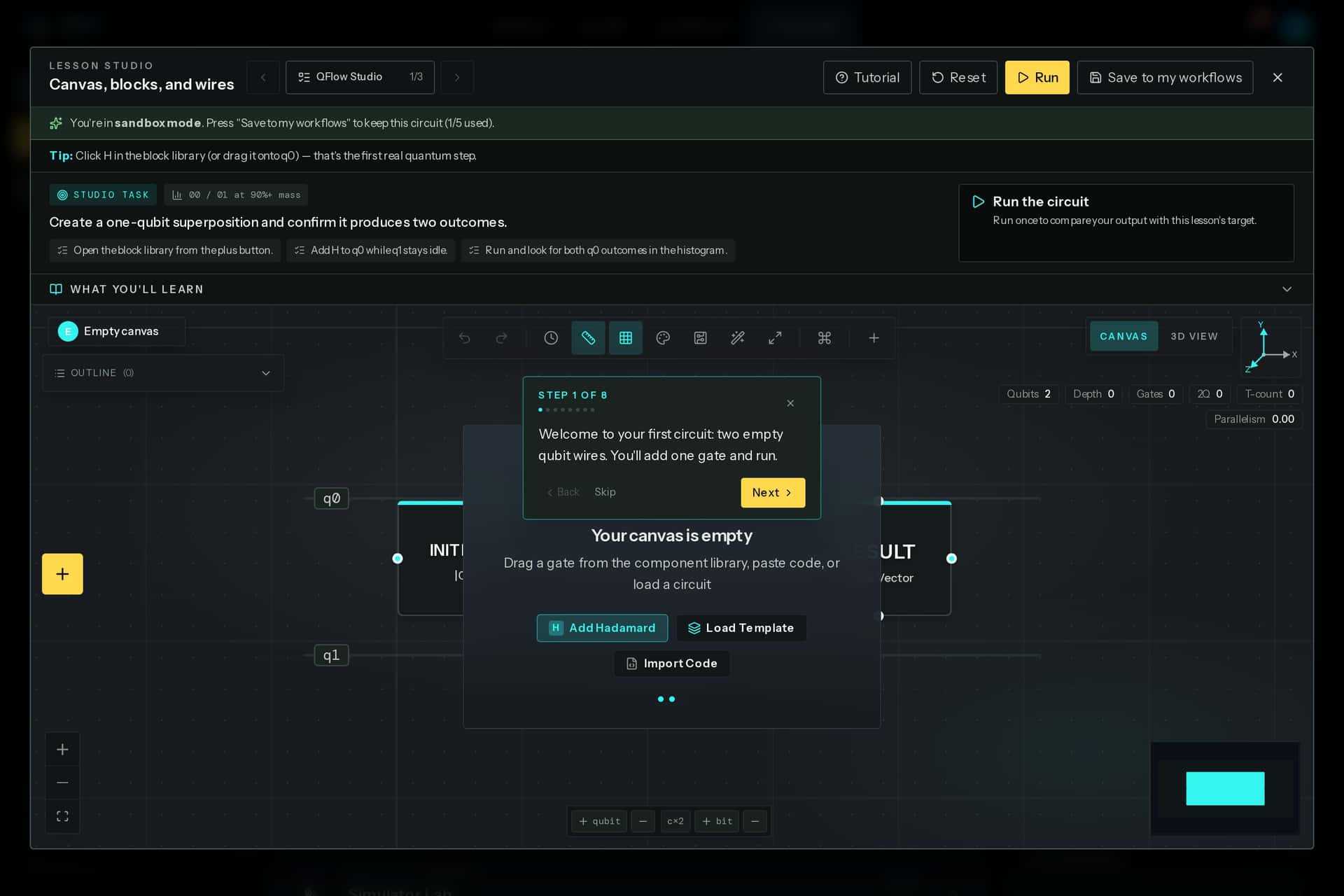
The pilot starts with compact, recognizable circuits and guided learning paths. Participants can move between Design and Code, inspect how an operation maps across both views, and use simulation to catch structural mistakes before considering hardware. Runs preserve counts, status, and the workflow revision that produced them, so a result can be reviewed instead of treated as a screenshot.
The test is broader than whether a button works. We will look at first-run comprehension, circuit editing, code synchronization, queue and provider language, result interpretation, and collaboration handoff. Participants will be asked where the interface creates confidence, where it slows them down, and which explanations arrive too early or too late. The goal is a small number of actionable observations tied to a real step in the workflow.
How feedback becomes a product decision
Feedback is most useful when it names the task, the expected outcome, the observed outcome, and the evidence needed to reproduce the issue. QFlow will collect pilot notes around those fields rather than asking for vague ratings alone. A confusing gate placement, an unclear run state, or a difficult result panel should be traceable to the workflow state in which it appeared.
The team will group findings into comprehension, correctness, reliability, and learning support. Repeated friction can become a product change; a one-off preference can remain a note; and a safety or data-boundary issue can block expansion until it is resolved. This keeps the pilot honest. Participation does not guarantee that every suggestion ships, but every accepted change should have a reason and a way to verify that the original problem improved.
The operating boundary stays explicit
This announcement describes a test pilot with the Quantum Hacettepe student community. It does not describe a procurement decision, a university-wide rollout, or an endorsement by Hacettepe University. Access remains scoped to the participating cohort, and QFlow's normal workspace, role, quota, notification, and provider-credential boundaries continue to apply.
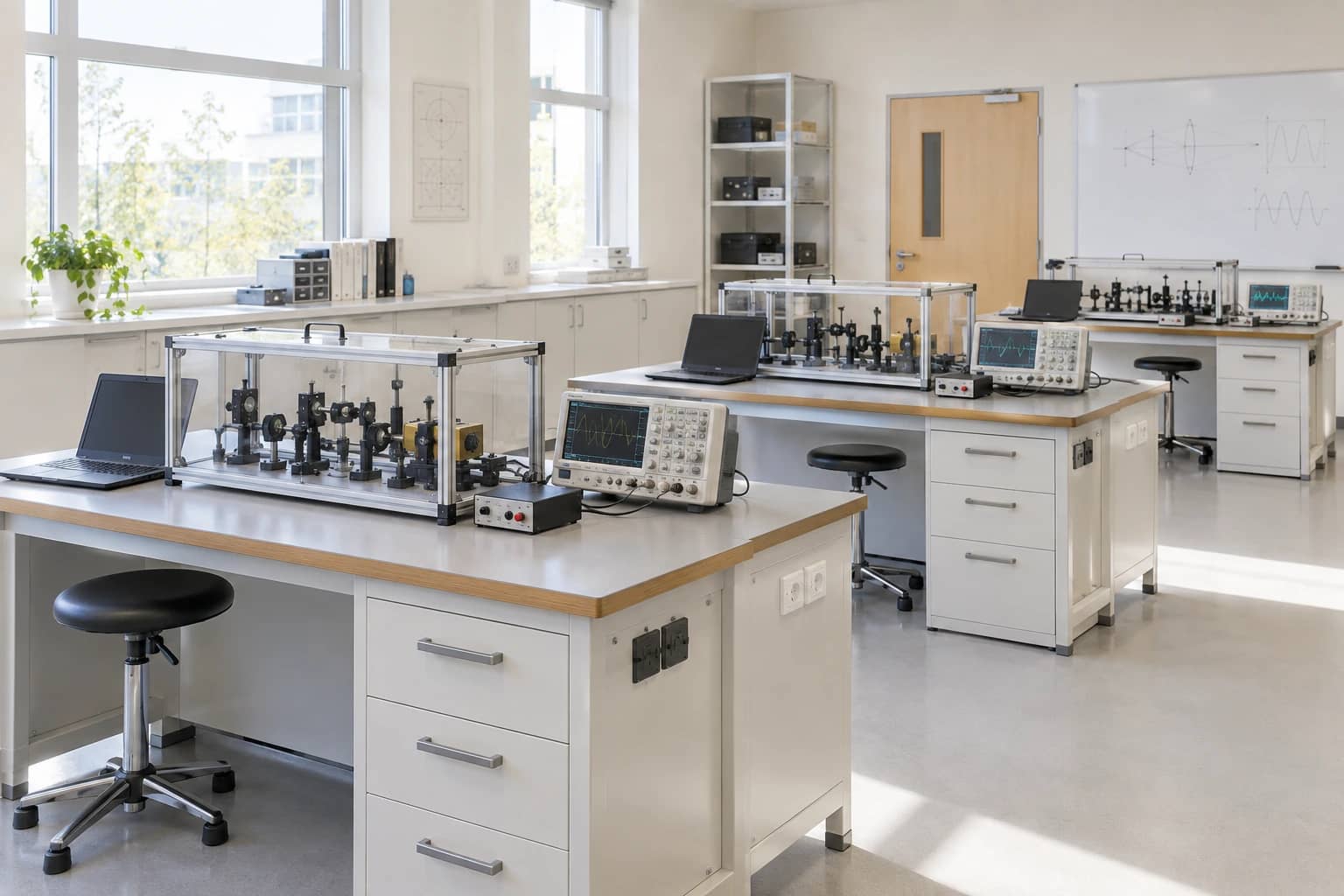
The laboratory visual provides learning context. Participant feedback and workflow records document the pilot, separating planned activities from completed sessions and observed outcomes.
What we will report next
The first useful follow-up will not be a celebration metric. It will be a compact operating note: which workflows were attempted, which steps were completed, where participants needed help, which product changes were accepted, and which questions remain open. Any shared examples will be stripped of credentials and private workspace data.
If the pilot shows that teams can move from learning to a reviewable simulation record with less friction, the next phase can test more varied circuits and organization-led learning assignments. If it exposes gaps, those findings are equally valuable. The purpose of a test pilot is to produce a better decision about the product and the program, not to manufacture a success story in advance.
What changes for the reader
QFlow begins a community test pilot with Quantum Hacettepe matters when it changes a decision the team can make now: which route to test, which assumption to record, which result to preserve, or which claim needs another source. The useful starting point is 1 shared workflow record. Treat it as a question to verify, not a conclusion to repeat.
Start with Hacettepe University Student Communities, compare the claim with the supporting sources, and label the boundary between current access, controlled research, and roadmap language. That keeps the article useful to technical leads and reviewers without flattening every source into the same confidence level.
Evidence to carry forward
A team should leave with a compact record: the source and review date, the claim being tested, the selected provider or simulator route, the expected artifact, and the fallback if the result is weak. Those details are enough to turn reading into a repeatable experiment without copying an entire article into the workspace.
Keep credentials, provider billing state, and private notes inside the account boundary. The shareable result should explain what was tested, what changed, and what still needs review.
The next decision
Choose one action that can be checked in the next review cycle: reproduce a result, compare two routes, update a learning module, or retire an assumption that no longer matches current access. Name an owner and a review date so the source trail does not become passive background reading.
If the evidence changes route selection, cost, security, or the expected artifact, update the related workflow and reviewer packet together. If it changes none of those things, keep it as context rather than creating extra process.
Questions this guide answers
Q01
Is this a Hacettepe University-wide deployment?
No. This is a scoped product test pilot with the Quantum Hacettepe student community, not a university-wide deployment, procurement decision, or institutional endorsement.
Q02
What will participants use in QFlow?
The cohort will work with visual circuits, synchronized generated code, simulation results, learning paths, and structured review records inside the access and quota boundaries assigned to the pilot.
Q03
How will pilot progress be evaluated?
Progress is evaluated through completed circuit workflows, simulation records, participant feedback, and accepted improvements. Published examples exclude private workspace data and credentials.
Next step
Turn this research into a workflow pilot.
Use the same source-to-workflow logic inside the studio: brief, route, run, evidence, and review in one packet.