private credentials
Provider connections
Saved keys and provider schemas live behind authenticated account settings.
Integrations / provider fabric
QFlow makes integrations operational: encrypted provider credentials, device discovery, preflight context, simulator routes, submit-capable beta paths, hardware polling, run history, and reviewer-safe evidence stay around one workflow record.
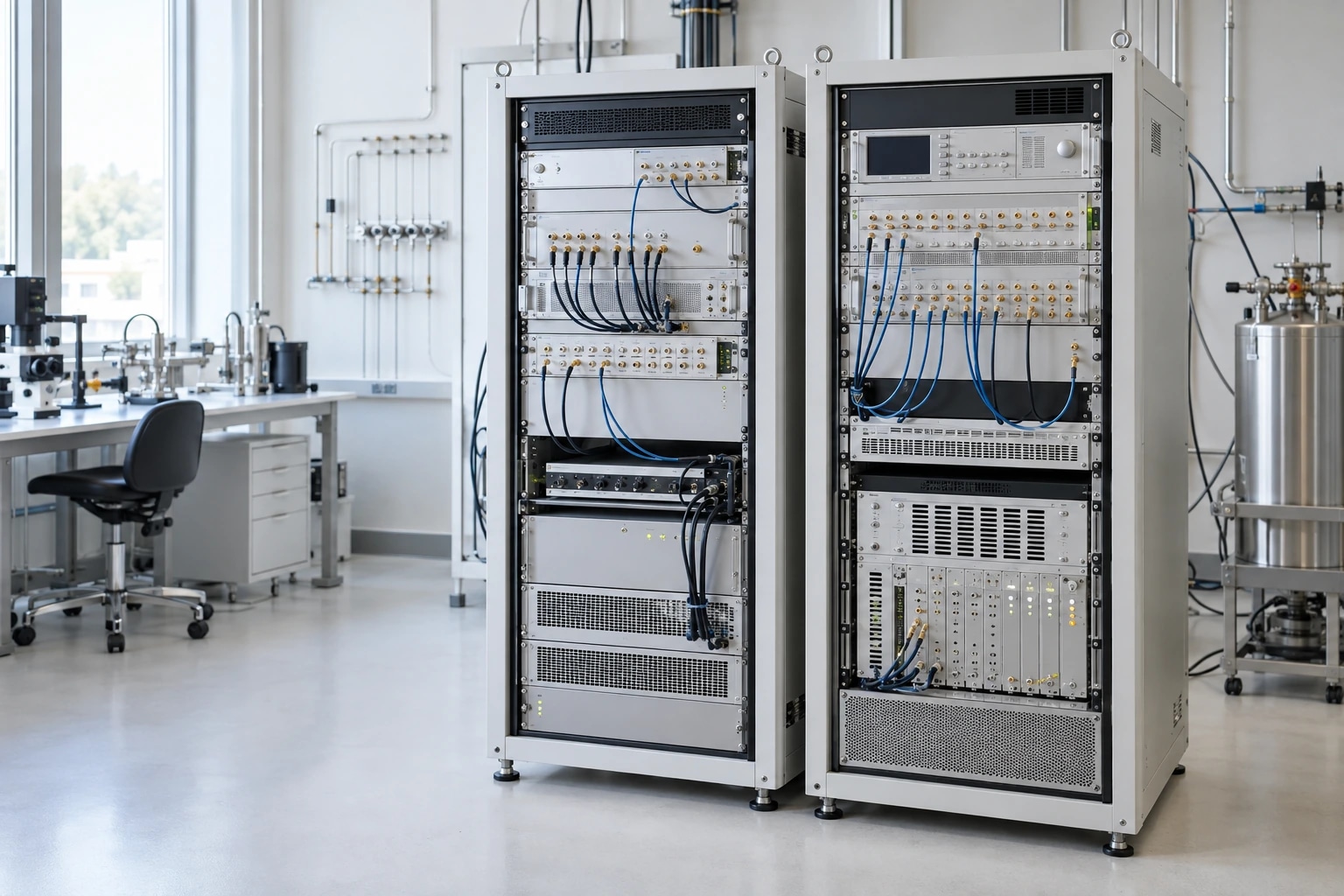 Provider fabric / QFlow
Adapter audit: 2026-06-03
Review available routes, account requirements and limits before choosing a provider.
Ecosystem context
QFlow references provider and SDK ecosystems independently. It does not imply affiliation, certification, endorsement, or guaranteed account access.

Qiskit

Cirq

IBM Quantum

AWS Braket

Azure Quantum

IonQ

Rigetti
Google Quantum AI

Quantinuum

OQC

D-Wave
QuEra

Pasqal

OpenQASM

NVIDIA CUDA-Q
private credentials
Saved keys and provider schemas live behind authenticated account settings.
workflow context
The canvas keeps provider and device choice attached to generated source and run state.
evidence trail
Completed, failed, and hardware-bound runs are reviewable without exposing private tokens.
Qiskit Aer, Cirq, and OpenQASM paths run public samples without provider credentials.
Implemented adapters can submit, poll, and map results where the provider account has access.
Some adapters check credentials, targets, workspace context, or estimator fit before direct submit exists.
Analog and annealing workflows stay planned until they have their own model instead of a forced gate path.
Provider status overview
The public matrix is a product-status explanation, not a live provider account check. It shows the adapter layer while private token tests stay inside authenticated provider surfaces.
Hardware and simulator
Authenticated job submit, job polling, backend listing, and result retrieval through the IBM adapter.
Requires IBM IAM access, service CRN, backend access, and provider-side job limits.
Source contextOpenQASM task path
Device listing and OpenQASM task submission path with S3 result location when credentials are configured.
Hybrid Jobs are not the public QFlow submit path yet; direct tasks need AWS region, role, device ARN, and S3 bucket.
Source contextHardware and simulator
Credential validation, backend listing, constrained circuit submission, polling, and result mapping.
Unsupported operations must be decomposed before submit; provider quotas and backend access still apply.
Source contextHardware and emulator
Nexus credential flow, device discovery, submit, polling, and result mapping.
Backend access, project permissions, and provider-side payload constraints apply.
Source contextTarget list, workspace preflight
Credential validation, workspace target discovery, and resource-estimator positioning.
Direct hardware job submission is intentionally disabled in the adapter until upload/SAS handling is implemented.
Source contextAnnealing and hybrid solvers
Credential validation and solver/device catalog context.
QFlow does not submit gate-circuit jobs to D-Wave; annealing workflows need a separate Ocean-style model.
Source context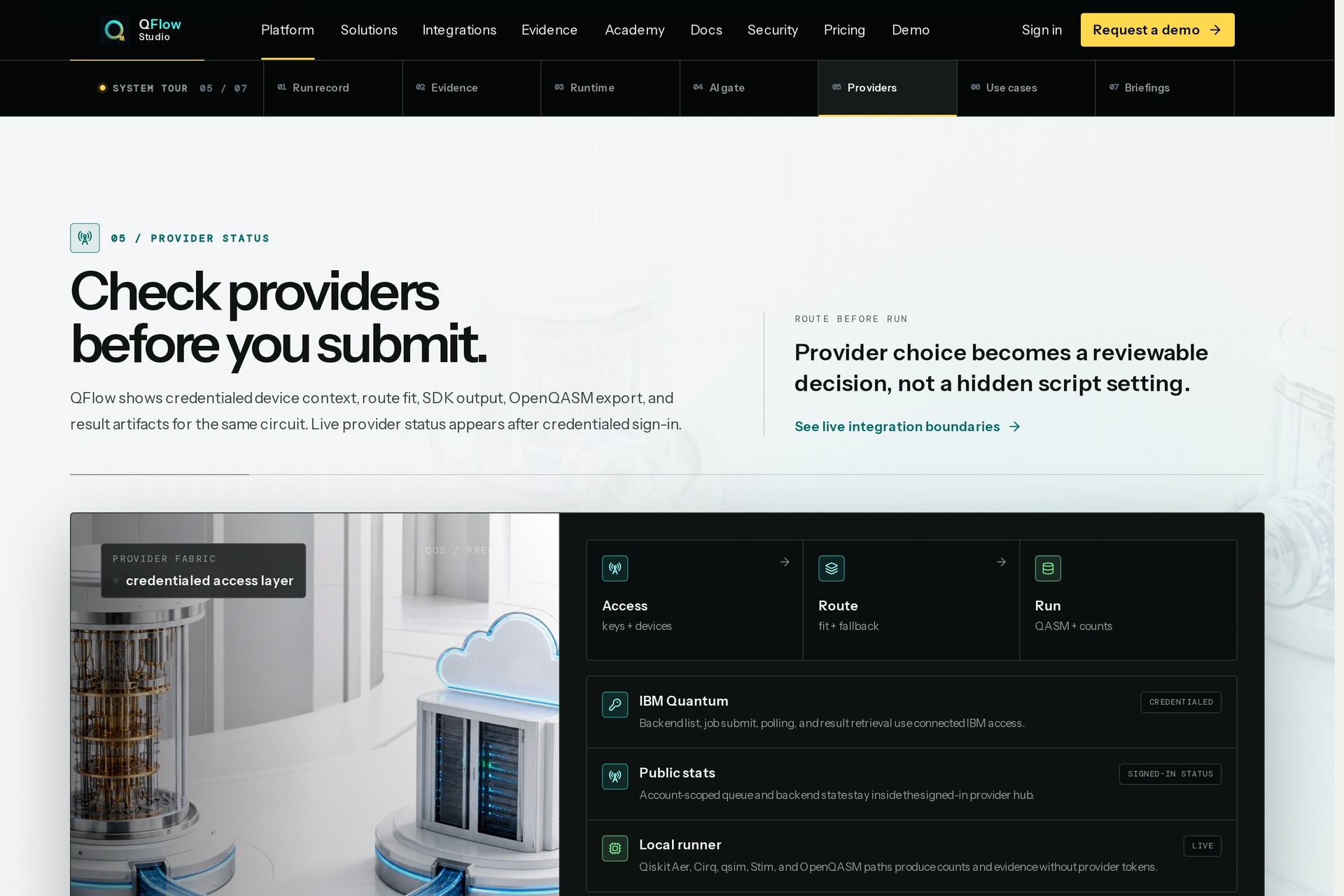
AWS, Azure, IBM, IonQ, Rigetti, Quantinuum, and OQC paths stay visible with their own access limits.
D-Wave, QuEra, and Pasqal are represented as specialized paths instead of mislabeled gate-circuit submit.
Counts, source, trace, route notes, and CSV exports stay with the run history.
Provider tokens, billing state, admin notes, and raw credentials stay out of public proof.
No affiliation claim