Loading topics
Skip to content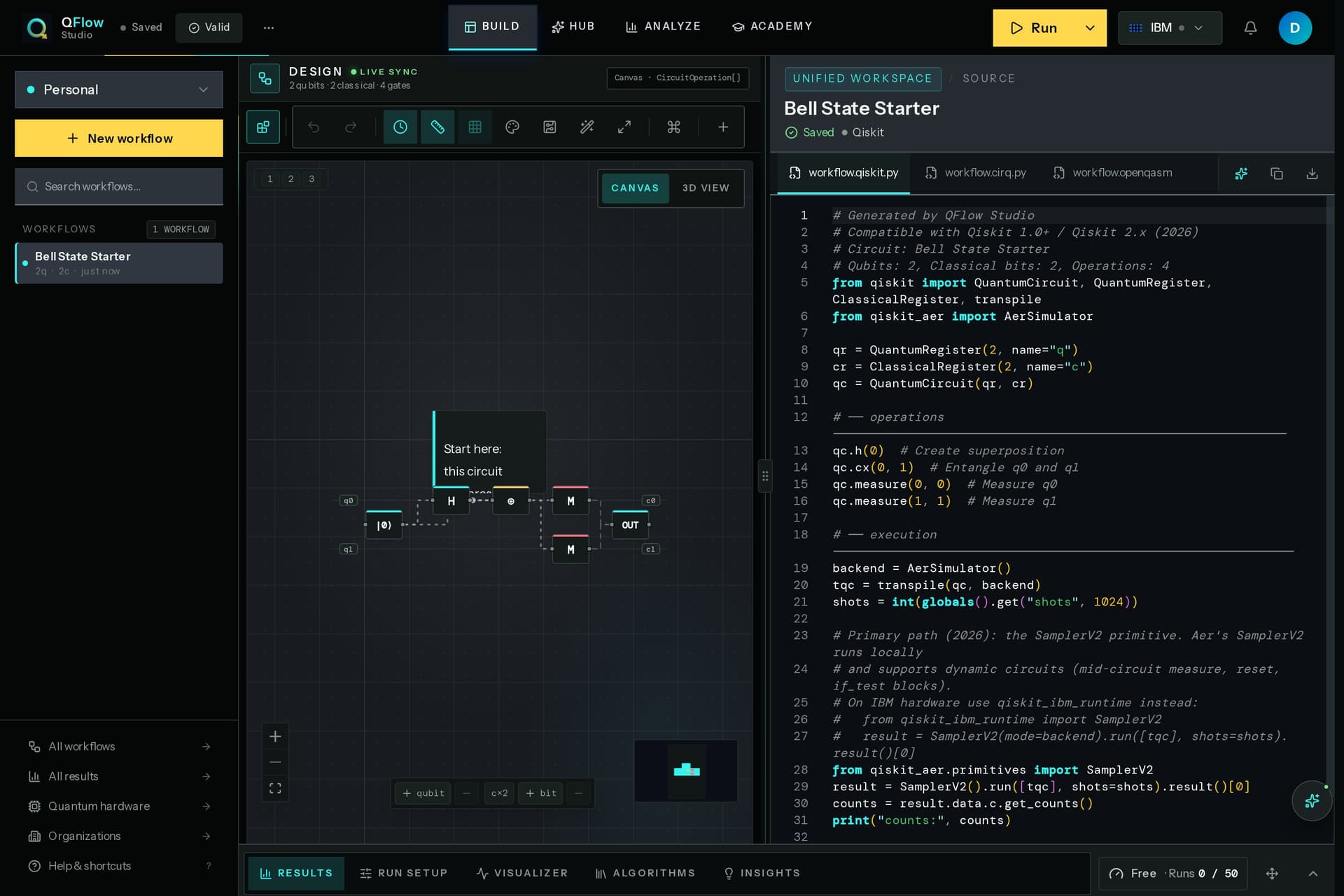
Sign in
Open navigation
EnglishPillarReviewed Aug 20, 2026
Quantum workflow pillar
Quantum workflow
A quantum workflow is the repeatable path from problem intent to circuit, provider route, execution result, and reviewable proof.
What the page helps answer
Define quantum workflow stages
What the page helps answer
Define quantum workflow stages
Explain run results
Connect SDKs and provider routing
Plan a simulator-first pilot
Teams no longer search only for a quantum circuit editor. They search for a workflow that survives handoff from researcher to platform owner, learner, security reviewer, and technical sponsor.
QFlow Studio treats the workflow record as the durable unit: brief, visual blocks, generated source, provider context, run status, and evidence stay together.
Topic decision guide
Use this page as an operating brief, not only a definition.
A quantum workflow is the repeatable path from problem intent to circuit, provider route, execution result, and reviewable proof.
Evidence checklist
Name the workflow goal before choosing a provider or SDK route.
Keep the circuit, generated source, simulation notes, run state, and result evidence in one record.
Separate independent ecosystem references from affiliation, certification, replacement, or partner claims.
Link the reader to docs, source-backed analysis, or a bounded pilot only after the decision context is clear.
Questions this topic should answer
What is quantum workflow?
A quantum workflow is the repeatable path from problem intent to circuit, provider route, execution result, and reviewable proof. In QFlow, the practical record keeps the objective, circuit or model, simulation check, provider route, run status, result analysis, and reviewer-safe evidence together.
How should a team evaluate Quantum workflow?
Start from this page intent: A quantum workflow is the repeatable path from problem intent to circuit, provider route, execution result, and reviewable proof. Then verify whether the workflow can produce the outcomes listed here before moving into docs, analysis, or a pilot request.
Which ecosystems are relevant to quantum workflow?
This page references IBM Quantum, Qiskit, AWS Braket, Azure Quantum, NVIDIA CUDA-Q, Cirq as independent ecosystem context and links source notes so readers can verify terminology without confusing QFlow with an official provider claim.
What belongs in a quantum workflow
01A complete workflow captures the business or research objective before the circuit is built, then keeps the circuit, code, simulator checks, backend choice, execution status, counts, and exports tied to that same record.
This matters because quantum work often crosses notebooks, SDKs, cloud provider consoles, classroom systems, and executive review. The workflow is the layer that keeps those artifacts explainable.
Where provider tools fit
02Qiskit, Braket, Azure Quantum, CUDA-Q, Cirq, and other tools each solve important parts of the stack. A workflow layer should make their role explicit without pretending to replace the underlying ecosystem.
QFlow focuses on orchestration, learning context, evidence, and review boundaries around those tools.
Independent ecosystem context
Independent ecosystem context
QFlow Studio is independent. IBM Quantum, Qiskit, AWS Braket, Azure Quantum, NVIDIA CUDA-Q, Cirq, Classiq, and Quantinuum Nexus are trademarks or products of their respective owners.
IBM Quantum
Referenced only as ecosystem context for workflow, learning, routing, or comparison intent.
Qiskit
Referenced only as ecosystem context for workflow, learning, routing, or comparison intent.
AWS Braket
Referenced only as ecosystem context for workflow, learning, routing, or comparison intent.
Azure Quantum
Referenced only as ecosystem context for workflow, learning, routing, or comparison intent.
NVIDIA CUDA-Q
Referenced only as ecosystem context for workflow, learning, routing, or comparison intent.
Cirq
Referenced only as ecosystem context for workflow, learning, routing, or comparison intent.
2026 source notes
Source-backed terminology.
These public sources shape the terminology and search intent for this page.
QFlow Studio
Continue from the topic page into docs, source-backed blog analysis, or a bounded pilot request.