Hardware evidence is becoming the buyer's interface
Q-CTRL's 2026 materials result and IBM platform updates show why provider readiness, error suppression, and artifact trails need first-class product surfaces.
4 chapters
11 focused sections
7 sources
primary links
3 signals
operating context
879 words
reviewed analysis
Near-term quantum value depends on a chain of operational proof: backend choice, shot budget, error-aware compilation, runtime behavior, and a clear comparison boundary. That proof has to be visible enough for technical teams and legible enough for business review.
3,000x
reported speedup
Q-CTRL materials simulation announcement
2 min
run window
reported quantum execution time in the announcement
private
credentials
tokens and billing context stay outside shared packets
Do not hide the preflight
Provider status, credential scope, queue estimate, and fallback path are not admin details. They are part of the workflow decision, especially when teams are comparing simulator, dry-run, and hardware modes.
Evidence needs boundaries
A reviewer should see counts, circuit snapshots, exports, and trace events. They should not see provider tokens, billing owners, or unrelated admin context. A clean product surface makes that boundary explicit.
Error-aware work belongs in the same view
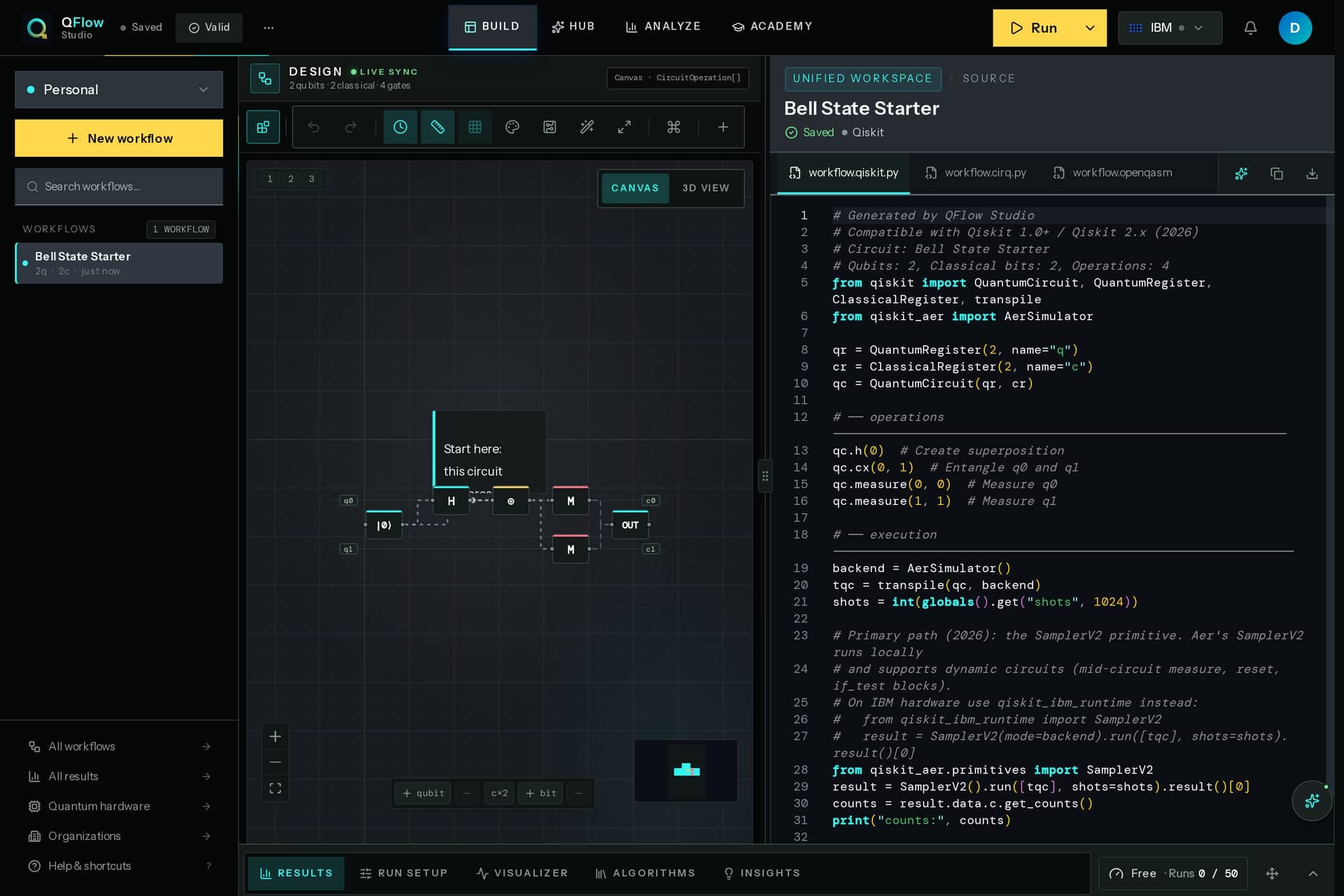
Error suppression and performance management are now part of the practical workflow. The UI should show compiler checks, route changes, depth changes, and evidence packet readiness near the run controls.
Buyer interfaces need tradeoff visibility
The buyer does not only need to know whether a run completed. They need to understand the operating tradeoff: why this backend, why this shot budget, why this mitigation path, and what changed between simulation and hardware.
A workflow product can make those tradeoffs readable by placing queue state, route rationale, run mode, and artifact readiness in one compact decision view. That is more useful than a generic dashboard with every subsystem exposed at once.
Operational handoff should be explicit
When an experiment becomes an enterprise pilot, ownership changes. Researchers, platform teams, procurement, and security reviewers all need different slices of the same record.
QFlow should let the technical team keep the full workspace while producing a clean packet for reviewers: circuit snapshot, counts, trace, source context, and the explicit statement that provider credentials and billing controls remain private.
Evidence starts before execution
A run packet should begin at preflight. Provider availability, credential scope, queue estimate, backend constraints, compiler warnings, mitigation mode, and fallback path all shape the meaning of the result. If those details are missing, the counts at the end are only half the story.
QFlow should make preflight evidence visible in a calm way. The user should see the active route, the reason it passed, the private boundary, and the fallback route without being forced into an admin console.

Error suppression needs comparison frames
Error suppression and performance management are most useful when users can compare before and after states. Did depth change? Did the compiler choose a different mapping? Did mitigation alter shot requirements? Did route confidence improve or simply move uncertainty elsewhere?
A professional evidence surface should keep those comparison frames near the run, not buried in logs. The goal is not to overwhelm the user with diagnostics. The goal is to preserve the handful of facts a reviewer will need later.
Private operations must stay private
Evidence packets should not leak credentials, billing settings, provider tokens, or workspace-private notes. That boundary is part of the product promise. A technical reviewer needs circuit, counts, trace, and route context; an admin needs roles and billing; neither should accidentally receive the other's secrets.
QFlow can make this boundary explicit by generating reviewer-safe packets from the same workflow record. The full workspace remains operational, while shared proof stays narrow and useful.
What changes for the reader
Hardware evidence is becoming the buyer's interface matters when it changes a decision the team can make now: which route to test, which assumption to record, which result to preserve, or which claim needs another source. The useful starting point is 3,000x reported speedup. Treat it as a question to verify, not a conclusion to repeat.
Start with Q-CTRL, compare the claim with the supporting sources, and label the boundary between current access, controlled research, and roadmap language. That keeps the article useful to technical leads and reviewers without flattening every source into the same confidence level.
Evidence to carry forward
A team should leave with a compact record: the source and review date, the claim being tested, the selected provider or simulator route, the expected artifact, and the fallback if the result is weak. Those details are enough to turn reading into a repeatable experiment without copying an entire article into the workspace.
Keep credentials, provider billing state, and private notes inside the account boundary. The shareable result should explain what was tested, what changed, and what still needs review.
The next decision
Choose one action that can be checked in the next review cycle: reproduce a result, compare two routes, update a learning module, or retire an assumption that no longer matches current access. Name an owner and a review date so the source trail does not become passive background reading.
If the evidence changes route selection, cost, security, or the expected artifact, update the related workflow and reviewer packet together. If it changes none of those things, keep it as context rather than creating extra process.
Next step
Turn this research into a workflow pilot.
Use the same source-to-workflow logic inside the studio: brief, route, run, evidence, and review in one packet.