Quantum AI control plane 2026: calibration, QML, and proof
A source-backed operating guide to quantum AI across calibration models, decoder assistance, QPU-GPU feedback loops, QML claims, and evidence review.
3 chapters
8 focused sections
6 sources
primary links
3 signals
operating context
776 words
reviewed analysis
Quantum AI in 2026 is strongest as a control plane, not as a vague claim that quantum replaces artificial intelligence. The credible work is calibration interpretation, decoder assistance, QPU-GPU feedback, QML benchmark review, and evidence preservation. QFlow should help teams record the model, data, route, run, and human decision before an AI suggestion changes a quantum workflow.
243
calibration samples
QCalEval gives plot-reading agents a named benchmark surface
60
logical-qubit caveat
QML advantage claims often assume future logical hardware
1
control packet
model, data, route, output, and approval stay together
Quantum AI is becoming the control plane
What is the quantum AI control plane in 2026? It is the layer where AI helps interpret calibration data, review decoder output, coordinate QPU-GPU loops, compare QML experiments, and prepare evidence for a human reviewer. That is more credible than claiming that today's QPUs are broadly replacing GPUs for AI workloads.
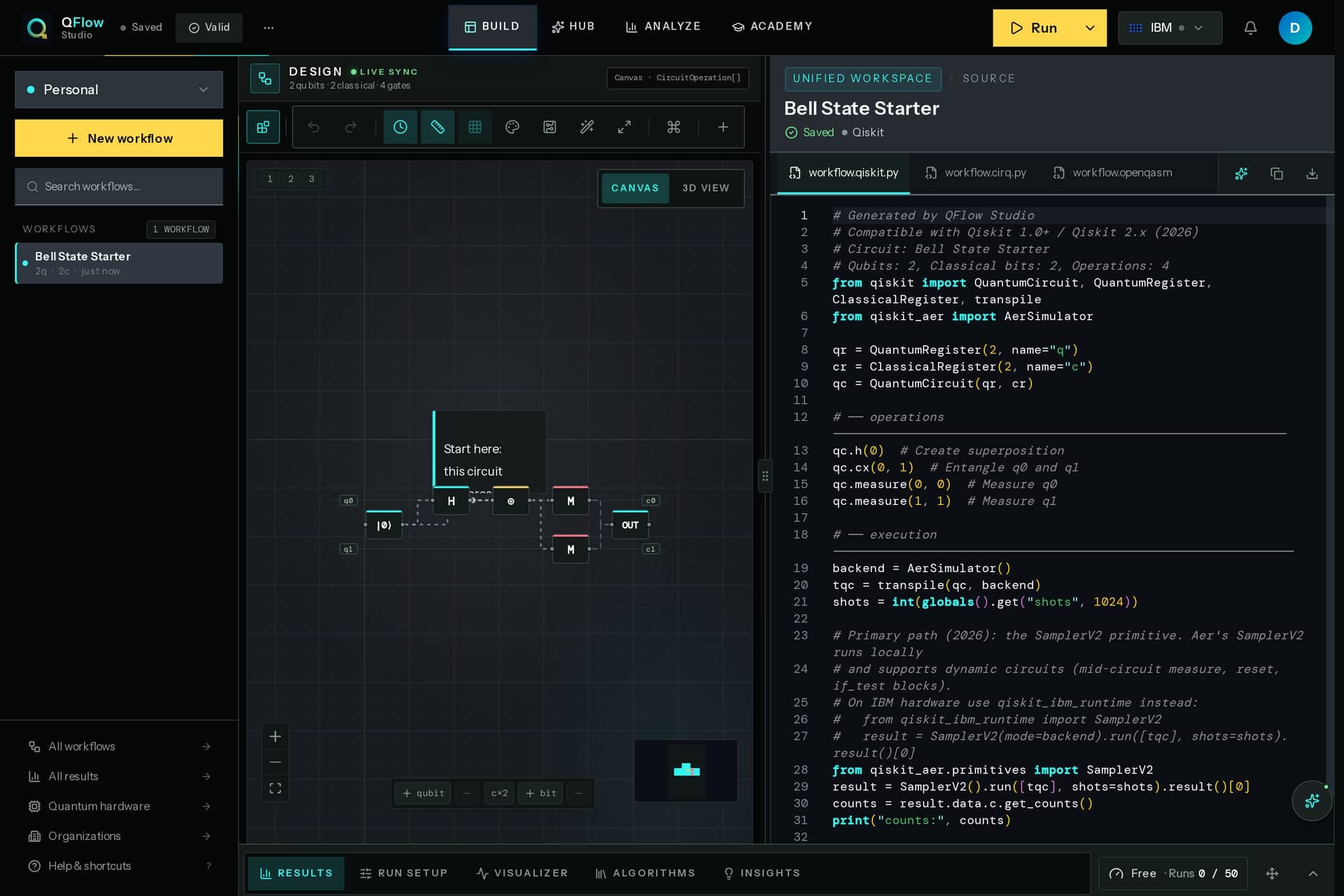
QFlow should make that distinction visible. The article should show which AI step is advisory, which step is simulated, which step touches provider execution, and which reviewer approved the final action.
Calibration and decoding are real AI targets
NVIDIA's Ising and QCalEval work make calibration plot understanding and decoder assistance concrete enough for an operating guide. The workflow question is whether the model saw the right data, understood the experiment family, and produced a recommendation that a hardware-aware reviewer can accept.
A useful QFlow packet should preserve input data, model version, task prompt, backend context, output, limitation, and approval. Without those fields, a quantum AI claim is hard to audit.
QPU-GPU loops need runtime boundaries
QPU-GPU feedback loops bring quantum AI closer to runtime. cudaq-realtime shows why microsecond callbacks, classical accelerators, and quantum execution should be described as one operating path.
That does not mean every agent can control hardware. QFlow should separate advisory analysis, local simulation, managed job execution, and hardware-owner approved runtime callbacks so the workflow remains safe and explainable.
QML claims need stronger baselines
Quantum machine learning research is active, but the evidence standard matters. Claims about massive classical data, reservoirs, kernels, or small-data learning should state data-loading assumptions, logical-qubit assumptions, noise behavior, and classical baselines.
QFlow should teach users to ask whether a QML result is theoretical, simulated, executed on current hardware, or validated against a strong classical method. That keeps the page useful without flattening every QML result into hype.
The product role is proof, not prediction
The product opportunity is to preserve proof. If an AI agent recommends a route, flags a calibration issue, or summarizes a QML result, the workflow should capture why it did so and what changed after review.
That makes quantum AI usable by teams. The article can be ambitious about AI-assisted quantum work while staying careful about what has actually been demonstrated in 2026.
What changes for the reader
Quantum AI control plane 2026: calibration, QML, and proof matters when it changes a decision the team can make now: which route to test, which assumption to record, which result to preserve, or which claim needs another source. The useful starting point is 243 calibration samples. Treat it as a question to verify, not a conclusion to repeat.
Start with NVIDIA Newsroom, compare the claim with the supporting sources, and label the boundary between current access, controlled research, and roadmap language. That keeps the article useful to technical leads and reviewers without flattening every source into the same confidence level.
Evidence to carry forward
A team should leave with a compact record: the source and review date, the claim being tested, the selected provider or simulator route, the expected artifact, and the fallback if the result is weak. Those details are enough to turn reading into a repeatable experiment without copying an entire article into the workspace.
Keep credentials, provider billing state, and private notes inside the account boundary. The shareable result should explain what was tested, what changed, and what still needs review.
The next decision
Choose one action that can be checked in the next review cycle: reproduce a result, compare two routes, update a learning module, or retire an assumption that no longer matches current access. Name an owner and a review date so the source trail does not become passive background reading.
If the evidence changes route selection, cost, security, or the expected artifact, update the related workflow and reviewer packet together. If it changes none of those things, keep it as context rather than creating extra process.
Questions this guide answers
Q01
What is the quantum AI control plane?
It is the workflow layer where AI assists calibration, decoder review, QPU-GPU feedback, QML comparison, and evidence preparation while humans keep execution-sensitive approval.
Q02
Does quantum AI mean QPUs replace GPUs for AI?
No. The strongest 2026 evidence is narrower: AI helps quantum systems operate, and selected QML studies explore future advantages under specific assumptions.
Q03
What should a quantum AI workflow record?
Record model version, input data, calibration or QML task, backend context, route, output, uncertainty, reviewer decision, and follow-up run metadata.
Next step
Turn this research into a workflow pilot.
Use the same source-to-workflow logic inside the studio: brief, route, run, evidence, and review in one packet.