Loading blog
A current map of Q4Bio, protein-ligand simulations, quantum chemistry, oncology workflows, clinical caveats, and healthcare evidence packets.
Related reading
hardware
A public-source guide to Rydberg RF sensing, robust quantum sensors, atomic receivers, defense caveats, lawful spectrum use, and validation evidence.
operations
A practical telecom guide to EuroQCI, satellite and free-space QKD, optical ground stations, PQC for non-terrestrial networks, and 6G security.
8 chapters
24 source notes
6 sources
primary links
3 signals
operating context
3,900 words
reviewed analysis
Quantum healthcare in 2026 has real research momentum, especially around Q4Bio, quantum chemistry, oncology-oriented workflows, and large protein-ligand simulations. The safe interpretation is still preclinical and computational. QFlow should help teams separate demonstrated quantum-classical workflow scale from clinical utility, drug approval, or treatment claims.

12,635
atoms
reported protein-ligand simulation scale from Cleveland Clinic, RIKEN, and IBM
$2M
Q4Bio prize
healthcare algorithm challenge signal for quantum biology workflows
0
clinical approvals
research milestones are not proof of patient benefit
What changed in quantum healthcare in 2026? Q4Bio and the Cleveland Clinic, RIKEN, and IBM protein-ligand work made healthcare quantum more concrete. The strongest claims are about workflow scale, quantum chemistry, algorithm design, and hybrid computation.
The article should also say what has not changed. These are not approved therapies, clinical diagnostic products, or proof that a quantum computer can replace established biomedical pipelines.
Q4Bio is important because it required teams to connect quantum algorithms to healthcare-relevant problems rather than stopping at toy circuits. That makes it a useful source for QFlow content.
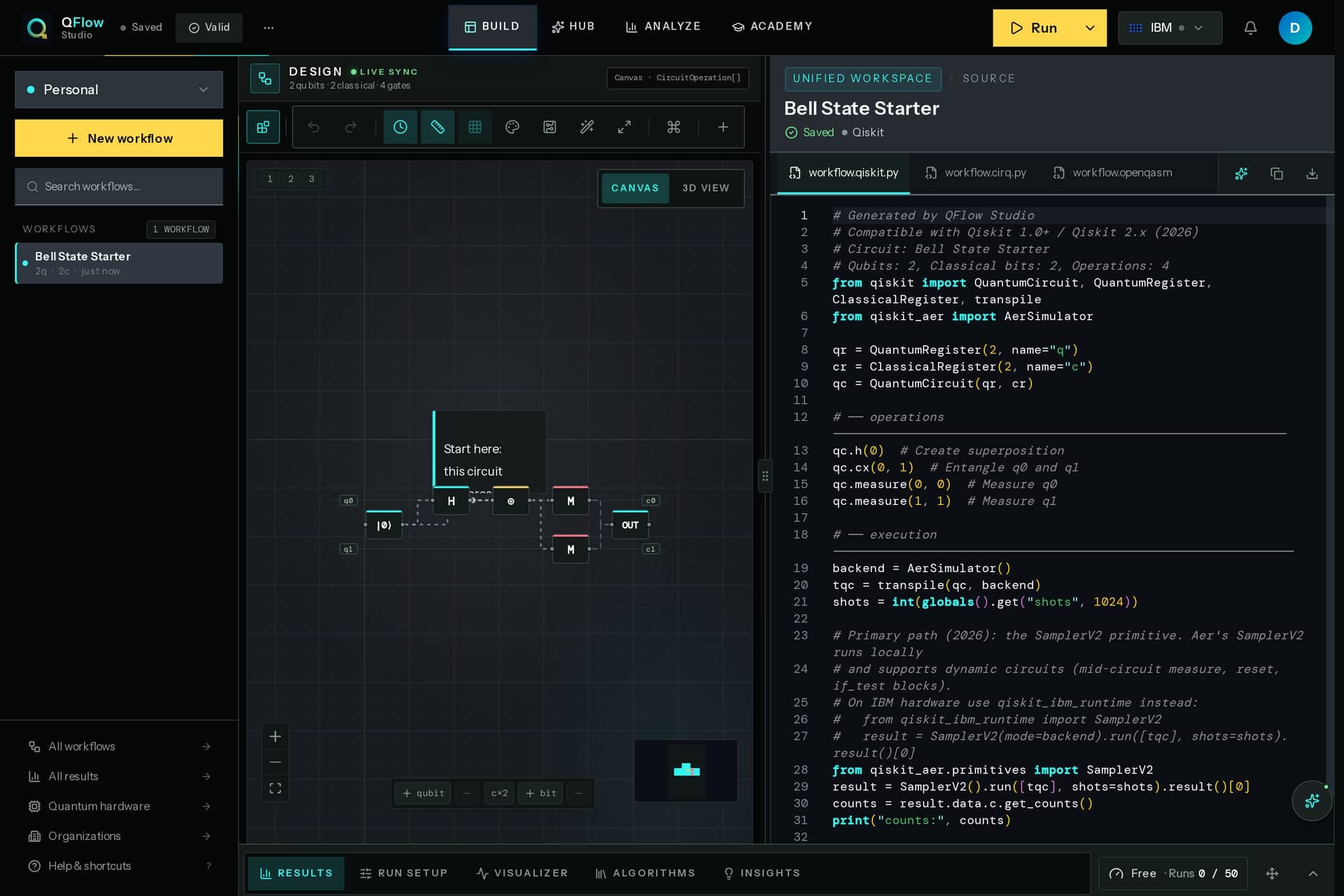
QFlow should translate the challenge into workflow fields: health question, molecule or dataset, quantum method, classical components, backend, validation target, and reviewer caveat.
The 12,635-atom protein-ligand simulation milestone is important because it shows quantum-centric supercomputing being applied to biologically meaningful molecular systems. It should be described as a computational chemistry milestone, not a finished drug discovery pipeline.
Q01
No broad clinical readiness is proven. The strongest 2026 evidence is computational and preclinical, especially around quantum chemistry, Q4Bio algorithms, and workflow scale.
Q02
It showed a large quantum-classical chemistry workflow on biologically meaningful protein-ligand complexes, not an approved drug discovery result.
Q03
Record the molecule or dataset, biological question, quantum method, classical components, backend, runtime, baseline, output, validation status, and reviewer conclusion.
Next step
Use the same source-to-workflow logic inside the studio: brief, route, run, evidence, and review in one packet.

education
A careful guide to quantum biology, quantum CRISPR claims, genomics, omics, cell-based therapeutics, biosensors, and what evidence teams should keep.
(c) 2026 QFlow Studio. Professional quantum workflow infrastructure.
Security: security@qflow.studio
The evidence packet should include molecule, fragmentation approach where relevant, QPU use, classical reconstruction, runtime, output, comparison, and known validation gaps.
Quantum machine-assisted drug discovery work is valuable when it states the comparator. Did the method improve a molecular generation task, an EGFR workflow, a photodynamic therapy simulation, or a resource estimate? What classical method was used, and what biological endpoint was checked?
Those are the questions a QFlow article should teach. A workflow that cannot name its baseline cannot make a durable healthcare claim.
Healthcare content must be explicit about scope. QFlow should use phrases such as computational, preclinical, in silico, research workflow, and validation needed where appropriate.
That restraint is not weakness. It is the editorial discipline that lets the article be useful to labs, product teams, and healthcare readers without sounding like medical marketing.
This IBM Newsroom source is included because it gives this article a concrete 2026-04-16 evidence point instead of a loose market claim. For a reader searching Quantum healthcare 2026, Quantum drug discovery, Q4Bio, the useful move is to ask what this source changes in practice: current access, roadmap confidence, route fit, run evidence, learning scope, or procurement risk. The evidence question is whether the source changes the vocabulary, practice task, provider comparison, or proof standard learners need before a pilot.
QFlow should connect that signal to academy modules, guided templates, route explanations, and hands-on evidence packets. The article should therefore treat IBM Newsroom as an input to an operating decision, not as decorative citation text. A team can copy the source into a workflow brief, attach the exact claim being tested, and decide whether the next step is simulation, hardware execution, resource estimation, provider comparison, or reviewer preparation.
The reviewer should see whether learners can explain the concept, reproduce the workflow, and distinguish current capability from future assumptions. That keeps the source trail useful months later. If IBM Newsroom updates the page, releases a new benchmark, changes access rules, or supersedes the claim, the affected workflow has a clear place to be reviewed rather than becoming stale background reading.

This Cleveland Clinic source is included because it gives this article a concrete 2026-05-05 evidence point instead of a loose market claim. For a reader searching Quantum healthcare 2026, Quantum drug discovery, Q4Bio, the useful move is to ask what this source changes in practice: current access, roadmap confidence, route fit, run evidence, learning scope, or procurement risk. The evidence question is whether the source changes the vocabulary, practice task, provider comparison, or proof standard learners need before a pilot.
QFlow should connect that signal to academy modules, guided templates, route explanations, and hands-on evidence packets. The article should therefore treat Cleveland Clinic as an input to an operating decision, not as decorative citation text. A team can copy the source into a workflow brief, attach the exact claim being tested, and decide whether the next step is simulation, hardware execution, resource estimation, provider comparison, or reviewer preparation.
The reviewer should see whether learners can explain the concept, reproduce the workflow, and distinguish current capability from future assumptions. That keeps the source trail useful months later. If Cleveland Clinic updates the page, releases a new benchmark, changes access rules, or supersedes the claim, the affected workflow has a clear place to be reviewed rather than becoming stale background reading.
This IBM Quantum Blog source is included because it gives this article a concrete 2026-05-05 evidence point instead of a loose market claim. For a reader searching Quantum healthcare 2026, Quantum drug discovery, Q4Bio, the useful move is to ask what this source changes in practice: current access, roadmap confidence, route fit, run evidence, learning scope, or procurement risk. The evidence question is whether the source changes the vocabulary, practice task, provider comparison, or proof standard learners need before a pilot.
QFlow should connect that signal to academy modules, guided templates, route explanations, and hands-on evidence packets. The article should therefore treat IBM Quantum Blog as an input to an operating decision, not as decorative citation text. A team can copy the source into a workflow brief, attach the exact claim being tested, and decide whether the next step is simulation, hardware execution, resource estimation, provider comparison, or reviewer preparation.
The reviewer should see whether learners can explain the concept, reproduce the workflow, and distinguish current capability from future assumptions. That keeps the source trail useful months later. If IBM Quantum Blog updates the page, releases a new benchmark, changes access rules, or supersedes the claim, the affected workflow has a clear place to be reviewed rather than becoming stale background reading.
This npj Drug Discovery source is included because it gives this article a concrete 2026-01-07 evidence point instead of a loose market claim. For a reader searching Quantum healthcare 2026, Quantum drug discovery, Q4Bio, the useful move is to ask what this source changes in practice: current access, roadmap confidence, route fit, run evidence, learning scope, or procurement risk. The evidence question is whether the source changes the vocabulary, practice task, provider comparison, or proof standard learners need before a pilot.
QFlow should connect that signal to academy modules, guided templates, route explanations, and hands-on evidence packets. The article should therefore treat npj Drug Discovery as an input to an operating decision, not as decorative citation text. A team can copy the source into a workflow brief, attach the exact claim being tested, and decide whether the next step is simulation, hardware execution, resource estimation, provider comparison, or reviewer preparation.
The reviewer should see whether learners can explain the concept, reproduce the workflow, and distinguish current capability from future assumptions. That keeps the source trail useful months later. If npj Drug Discovery updates the page, releases a new benchmark, changes access rules, or supersedes the claim, the affected workflow has a clear place to be reviewed rather than becoming stale background reading.
This Scientific Reports source is included because it gives this article a concrete 2026-03-21 evidence point instead of a loose market claim. For a reader searching Quantum healthcare 2026, Quantum drug discovery, Q4Bio, the useful move is to ask what this source changes in practice: current access, roadmap confidence, route fit, run evidence, learning scope, or procurement risk. The evidence question is whether the source changes the vocabulary, practice task, provider comparison, or proof standard learners need before a pilot.
QFlow should connect that signal to academy modules, guided templates, route explanations, and hands-on evidence packets. The article should therefore treat Scientific Reports as an input to an operating decision, not as decorative citation text. A team can copy the source into a workflow brief, attach the exact claim being tested, and decide whether the next step is simulation, hardware execution, resource estimation, provider comparison, or reviewer preparation.
The reviewer should see whether learners can explain the concept, reproduce the workflow, and distinguish current capability from future assumptions. That keeps the source trail useful months later. If Scientific Reports updates the page, releases a new benchmark, changes access rules, or supersedes the claim, the affected workflow has a clear place to be reviewed rather than becoming stale background reading.

Adding more article depth should not mean adding filler. The detail that matters is the connective tissue between source, implication, workflow, and review. A strong section explains what the source says, which assumption it changes, how a team would test the assumption, and what evidence would survive handoff to another reader.
That structure is especially important in 2026 because quantum announcements are moving quickly and use different confidence levels. Product pages describe access, roadmaps describe intent, research papers describe controlled experiments, and market reports describe commercial momentum. The blog needs to keep those categories separate while still giving the reader one practical path forward.
The article becomes product behavior when 0 clinical approvals is attached to a concrete workflow state. In QFlow, that should look like a source brief, a route note, a run mode, a fallback branch, an artifact checklist, and a reviewer-safe summary. The public page explains why the workflow exists; the studio preserves what the team did with it.
That connection also improves maintenance. If a source changes, the article, template, learning content, and review packet can be updated together. The product does not need a separate content strategy and operations strategy. It needs one source-to-workflow model that keeps 2026 research, provider updates, and market signals tied to decisions users can inspect.
Quantum healthcare and drug discovery 2026: evidence map answers a practical 2026 search question: how should a serious team interpret Quantum healthcare 2026, Quantum drug discovery, Q4Bio without confusing roadmap momentum with deployable operating capability. The short answer is to connect every claim to a workflow decision. If the claim changes provider choice, run mode, evidence requirements, learning scope, or procurement risk, it belongs in the operating record. If it does not change a decision, it should remain background context.
That answer matters because quantum searches in 2026 are full of mixed signals. Some pages describe current cloud access, some describe early fault-tolerant roadmaps, some describe research proofs, and some describe public-market momentum. The useful article separates those signals and tells the reader what to do next. For this topic, the next action is to turn the research into a narrow pilot packet with objective, route, fallback, artifact list, reviewer, and decision date.
This is also why the article favors sources over slogans. A reader should leave with the exact claims to inspect, the sources behind them, and the product surface where those claims become work. That is the standard QFlow should keep for every blog post: helpful, current, sourced, and directly connected to the studio.
Quantum healthcare and drug discovery 2026: evidence map should be read as an operating brief, not as a detached market note. The practical question is how a team would use this signal inside a live workflow: what changes in route selection, what evidence must be captured, which users need to see the result, and which private details must stay inside the workspace.
The useful product response is to keep the article close to the studio model. A team should be able to move from the source material into a workflow packet that records objective, owner, circuit or model state, provider path, execution mode, artifacts, and review notes. That packet is where strategy becomes operational memory.
This also changes how the blog should be maintained. Each article needs enough context for an executive reader to understand why the signal matters, enough implementation detail for a technical lead to frame a pilot, and enough source discipline for a reviewer to separate current capability from roadmap promise. Long-form content is valuable only when it reduces handoff loss between those readers, and when it leaves a clear path from reading to product action for the next review cycle. For this article, the operational lens is shared vocabulary, learner progression, provider literacy, and review-ready practice.
The source trail for this article starts with IBM Newsroom (2026-04-16), Cleveland Clinic (2026-05-05), IBM Quantum Blog (2026-05-05), Nature (2026 article). That matters because current quantum content often mixes vendor roadmap language, research language, cloud documentation, government policy, and market analysis. The article should not flatten those sources into one confidence level. It should explain which source describes live product behavior, which source describes research direction, which source describes policy or funding, and which source describes commercial adoption.
IBM Newsroom sets the first evidence anchor, while Cleveland Clinic and IBM Quantum Blog provide the cross-check. A workflow reader should ask a concrete question for each source: does this change what we can run today, what we should learn next, what provider route we should test, or what a reviewer must see before the pilot scales?
QFlow can encode that discipline in the product. Source links should not be decorative citations at the bottom of a page. They should become assumptions attached to workflows, route notes, lesson updates, and review packets. When a source is updated or superseded, the affected workflow should be easy to revisit.
Before a pilot based on Quantum healthcare 2026, Quantum drug discovery, Q4Bio scales, QFlow should require a small evidence checklist. The team needs a source brief, a route rationale, an expected artifact list, a fallback path, and a reviewer-safe summary. Without that checklist, 12,635 atoms can become an impressive number that nobody can reproduce or defend.

A practical implementation path should stay small. First, convert the article into one reusable workflow template with a clear objective and a recommended starting route. Second, attach the relevant sources, assumptions, and risk notes to that template. Third, run one dry path and one execution path where provider access allows it. Fourth, generate a reviewer packet that states what worked, what failed, and which assumption deserves the next experiment.
This keeps the article from becoming static content. The writing becomes a product input: it informs templates, route prompts, academy lessons, and admin review rules. The same structure also helps SEO because the page answers the reader's intent directly, then proves the answer through sections, sources, dates, and concrete next actions instead of keyword stuffing.
The implementation path should also protect teams from overcommitting. In 2026, quantum pilots are still sensitive to queue access, backend availability, SDK changes, pricing, and roadmap language. A narrow template lets the team learn quickly while keeping every claim testable.
The interface implication is straightforward: reduce copy-and-paste operations between research, provider consoles, spreadsheets, and review decks. A user reading this article should be able to create or update a workflow with the same assumptions: target modality, run mode, source links, expected outputs, risk notes, and next decision.
That does not require a noisy dashboard. It requires calm hierarchy. The active workflow remains the primary surface, while source context, metrics, route notes, and reviewer artifacts stay close enough to inspect. The result is a product that helps technical users move from analysis to action without losing the audit trail.
The admin surface should reinforce the same model. Editors need long articles that can carry real analysis, but they also need structured fields for sources, metrics, sections, and takeaways so the public page, RSS feed, sitemap, and Open Graph images stay consistent. The content system should therefore support depth without turning every update into a one-off page build. That is how a blog becomes part of the workflow product instead of a detached marketing layer.
This article should be reviewed whenever a major source changes, a provider updates access, or a market claim becomes stale. A good cadence for 2026 quantum content is monthly for valuation and company articles, quarterly for workflow and education articles, and immediate review for security, standards, and provider availability updates. The review date should be visible so readers understand that the page is maintained.
The maintenance rule is simple: update the article when a source changes the reader's decision. If a new benchmark does not change route selection, evidence requirements, or learning path, it can wait for the next scheduled review. If it changes a run path, procurement stance, or security boundary, the article and the related workflow templates should be updated together.
That cadence follows the practical SEO rule that useful, reliable, current content beats decorative freshness. The page should not be edited just to look active. It should be edited when the source trail, workflow recommendation, or reader action changes.
The caveat is that 2026 quantum signals are still uneven. Some announcements describe current access, some describe roadmap ambition, and some describe early evidence that needs careful replication. A serious team should label those categories explicitly instead of flattening them into a single confidence score.
The next decision should therefore be narrow. Pick one workflow that can be repeated, one provider or simulator route, one fallback path, and one evidence packet. If the team can explain that packet to a researcher, an operator, and a sponsor without rewriting the story, the article has done its job inside the product.
For a production beta, this means each article should end with decisions that are small enough to verify: which workflow to prototype, which provider route to compare, which artifact proves progress, and which assumption would stop rollout. That keeps the writing connected to live product behavior instead of becoming a static archive of optimistic market commentary. It also keeps future article updates grounded in what users actually tried.
The article should also strengthen QFlow's broader topical cluster. A reader who arrives through search should find a clean path into the studio, the academy, and related research without being pushed through unrelated marketing pages. That means each blog post should naturally connect to workflow templates, academy concepts, documentation, provider readiness, and demo intent.
The cluster logic is not about stuffing links. It is about helping readers keep context. A hardware article should point toward evidence and provider readiness. An education article should point toward lessons and practice. An operations article should point toward admin controls, audit trails, and procurement decisions. A workflow article should point toward the studio experience. This keeps the content useful for humans and easier for retrieval systems to understand as a coherent body of expertise.
The database record should match the public article, not a short placeholder. Every canonical post needs structured sources, metrics, sections, takeaways, publication status, and a review date that survives deployment. Admin-edited drafts can stay private, but published canonical records should not ship with thin summaries, missing citations, or disconnected headings.
That standard protects the product. RSS, sitemap, Open Graph images, JSON-LD, public pages, and admin previews all depend on the same content record. If the DB keeps stale short content while the static catalog improves, public users see an inconsistent product. The seed flow should therefore be able to update curated canonical records deliberately while still avoiding accidental hard resets or unrelated database changes.
Editors should treat the admin screen as the source of production truth after seeding. If a canonical article is changed manually, the change should keep the same minimum bar: enough words to answer the search intent, enough sections to scan, enough source links to verify claims, and enough operational detail to create a workflow from the page.

This Nature source is included because it gives this article a concrete 2026 article evidence point instead of a loose market claim. For a reader searching Quantum healthcare 2026, Quantum drug discovery, Q4Bio, the useful move is to ask what this source changes in practice: current access, roadmap confidence, route fit, run evidence, learning scope, or procurement risk. The evidence question is whether the source changes the vocabulary, practice task, provider comparison, or proof standard learners need before a pilot.
QFlow should connect that signal to academy modules, guided templates, route explanations, and hands-on evidence packets. The article should therefore treat Nature as an input to an operating decision, not as decorative citation text. A team can copy the source into a workflow brief, attach the exact claim being tested, and decide whether the next step is simulation, hardware execution, resource estimation, provider comparison, or reviewer preparation.
The reviewer should see whether learners can explain the concept, reproduce the workflow, and distinguish current capability from future assumptions. That keeps the source trail useful months later. If Nature updates the page, releases a new benchmark, changes access rules, or supersedes the claim, the affected workflow has a clear place to be reviewed rather than becoming stale background reading.
A reader should leave this article with a decision model, not just a longer list of names and numbers. The first decision is whether the topic changes something the team can do this quarter. The second is whether the claim depends on current access, future roadmap delivery, a simulated estimate, or a vendor-controlled benchmark. The third is whether the team has enough evidence to brief a sponsor without overstating the result.
For Quantum healthcare and drug discovery 2026: evidence map, the working model starts with 12,635 atoms. That signal should be translated into an operating question: what would we run, where would we run it, what fallback path would be acceptable, and what artifact would prove progress? QFlow should make those questions visible beside the workflow so the article can become a repeatable pilot plan.
This is especially important when the source trail starts with IBM Newsroom and is supported by Cleveland Clinic. Those sources may be credible, but the product still has to translate them into accountable workflow state. The article should help the user understand what to inspect next, while the application should preserve the facts that made the decision possible.
A useful evidence packet should include the source date, the claim being tested, the dependency that could break the claim, the human reviewer, and the expected next action if the run fails. That makes the workflow resilient when model access, queue conditions, pricing, hardware availability, or compliance requirements change. The point is not to slow pilots down; it is to make successful pilots repeatable and to make weak pilots fail before they consume more time. It also gives product, research, and operations teams the same language for deciding what ships next.