 Featured analysis
QFlow News & Research
Product news and current quantum workflow analysis.
Follow QFlow product releases, community pilots, and sourced 2026 reads on provider readiness, hybrid execution, review evidence, and the operating layer quantum teams need.
Featured analysis3 chapters6 sources8 images
education2026-09-025 min read
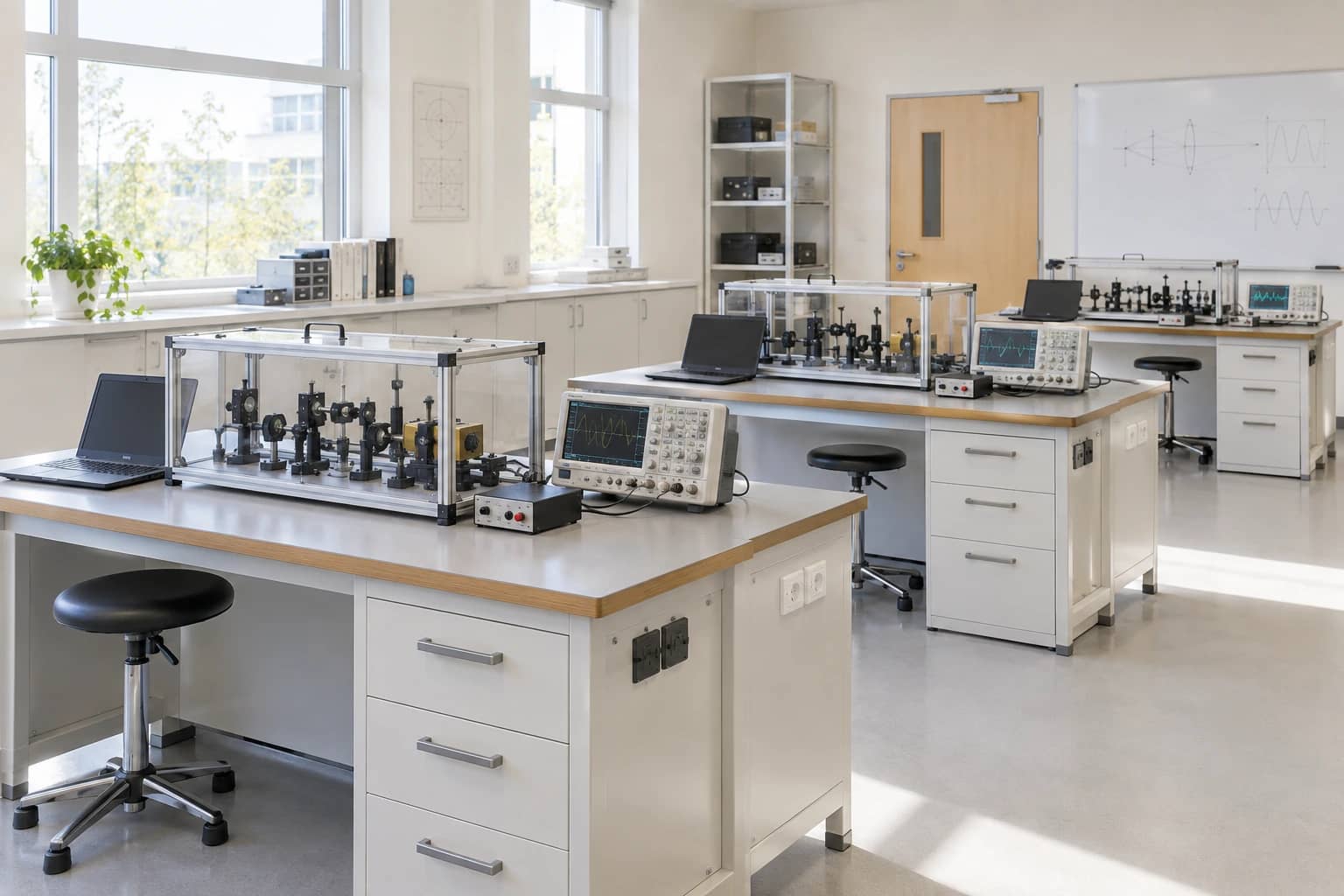
QFlow begins a community test pilot with Quantum Hacettepe
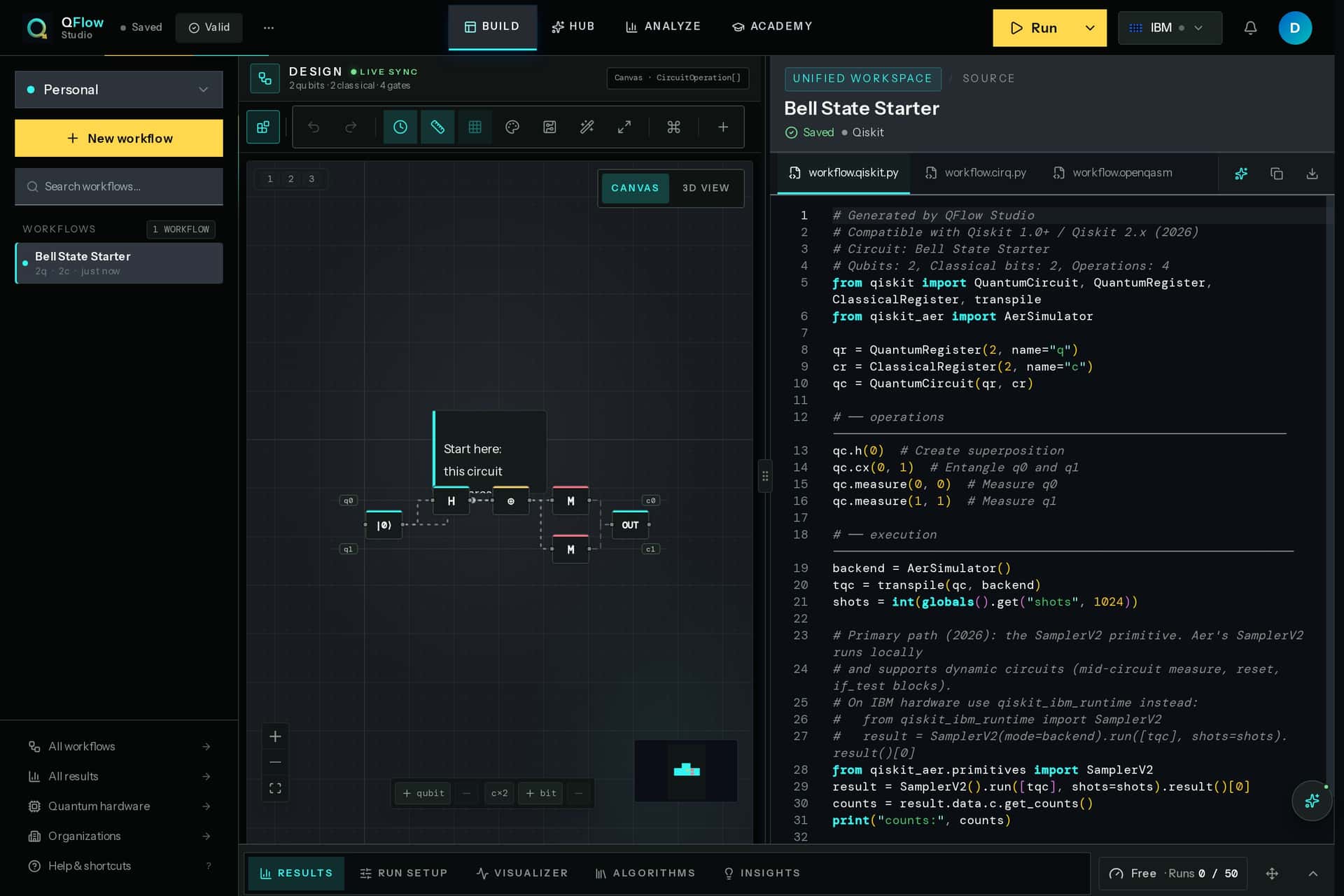
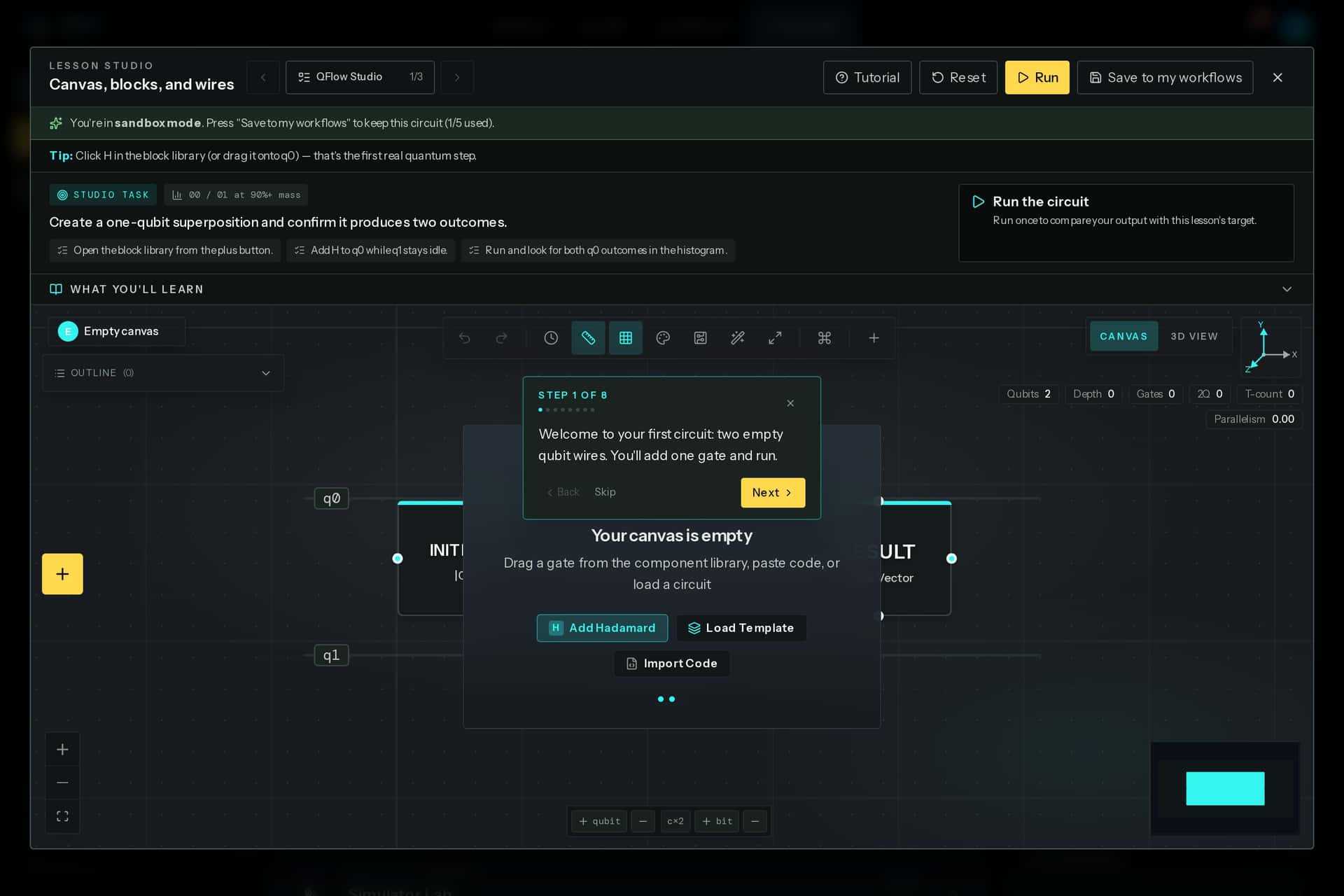
The scoped pilot will test how visual circuits, synchronized code, simulation evidence, and guided learning hold up in real student-team workflows.
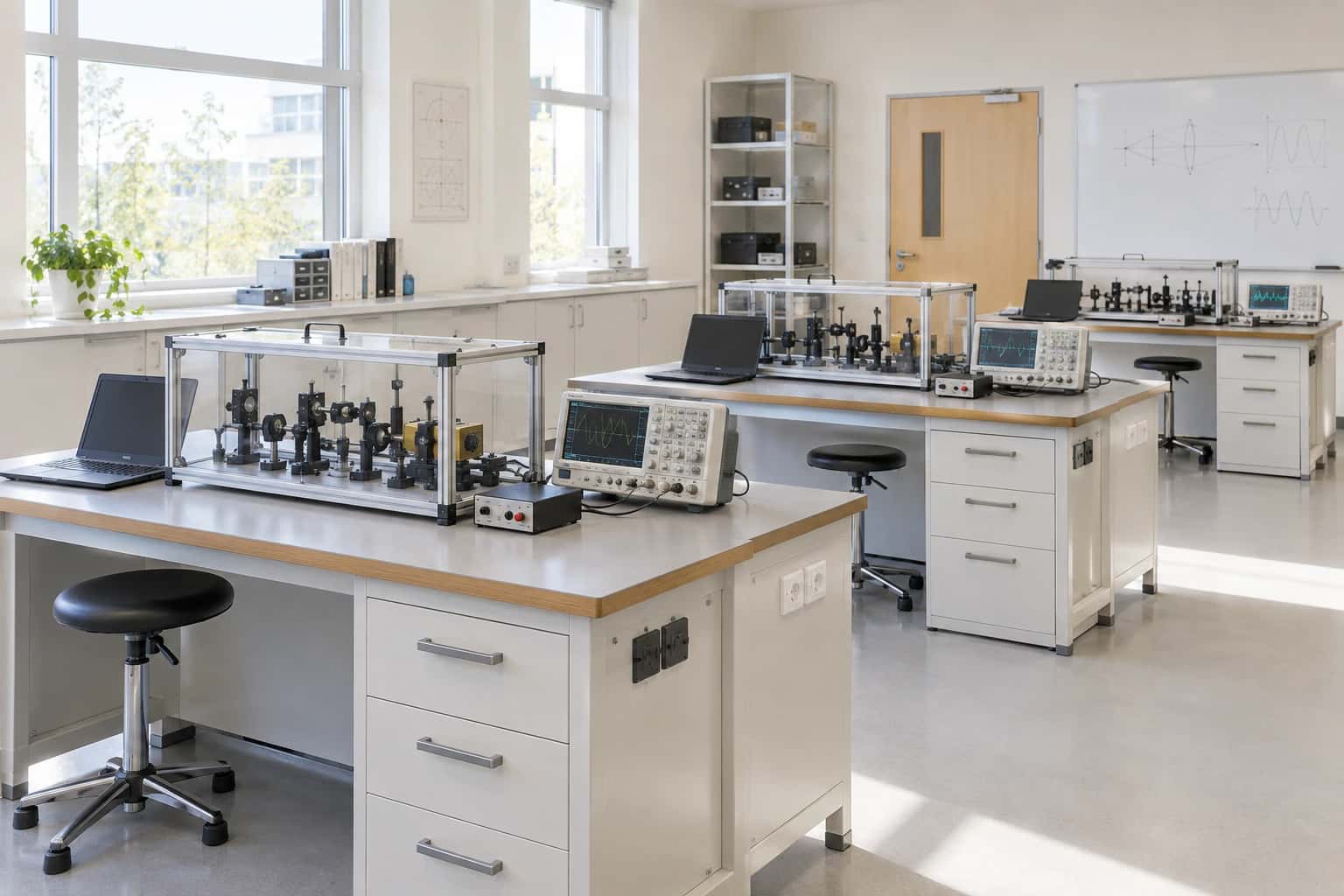
QFlow Studio and the Quantum Hacettepe student community are beginning a bounded test pilot focused on the daily work between learning a circuit and producing reviewable run evidence. Participants will work with the same circuit in Design and Code, use simulation before scarce hardware, and record concrete feedback on clarity, reliability, and team handoff. The pilot is a community product-testing program; it does not represent a university-wide deployment or institutional endorsement by Hacettepe University.
What this covers
Why this pilot existsWhat participants will actually testHow feedback becomes a product decision

QFlow NewsQuantum HacettepeQuantum educationQuantum workflow
Research library
Showing 21-30 of 36 guides, 10 articles per page.
8 images
hardware2026-05-304 min read
Dynamic quantum circuit benchmarking 2026: real workflows
Dynamic circuit searches need a benchmark lens: mid-circuit measurement, feed-forward, latency, drift, mitigation, and portable workflow evidence.
How should teams benchmark dynamic quantum circuits? They need to measure more than gate count or static depth. The 2026 search intent asks for mid-circuit measurements, feed-forward, schedule constraints, latency, mitigation, and evidence that a dynamic workflow can be compared across runs and providers. QFlow should make that benchmarking checklist visible in the blog listing and in the article body.
What this covers
Dynamic circuits change what a benchmark meansdynamarq gives the search cluster a benchmark nameFeed-forward is an evidence requirement
8 images
hardware2026-05-304 min read
AI for quantum calibration and control: 2026 workflow layer
AI calibration searches now point to benchmarked plot understanding, open decoder models, shared qubit data, and workflow evidence for tuning loops.
How is AI used for quantum calibration and control? In 2026, the useful answer is not a vague claim that AI will run hardware. It is a workflow layer around calibration plots, qubit data, decoder models, model confidence, human review, and evidence packets. QFlow should own this search by showing how AI-assisted tuning decisions stay traceable before they affect provider routing or research claims.
What this covers
AI quantum calibration needs evidence, not magicQCalEval makes plot understanding searchableOpen decoder models create a handoff problem
8 images
hardware2026-05-304 min read
Quantum error correction roadmap 2026: qLDPC and decoders
A practical guide to the 2026 QEC searches around logical qubits, qLDPC codes, real-time decoders, AI control, resource estimates, and evidence packets.
The quantum error correction roadmap 2026 search cluster is about evidence: how logical qubits, qLDPC codes, real-time decoder latency, AI-assisted control, and resource estimates translate into a workflow a team can review. QFlow should answer these searches by connecting hardware claims to reproducible assumptions and by making QEC progress understandable to product, research, and security teams.
What this covers
The QEC roadmap search has moved from promise to latencyqLDPC changes the resource-estimation conversationReal-time decoders make QEC operational
8 images
education2026-05-304 min read
Quantum research categories 2026: what teams should track
A maintained 2026 map of quantum research categories: QEC, resource estimation, benchmarking, AI control, dynamic circuits, and workflow evidence.
Quantum research categories in 2026 are converging around evidence, not hype. The useful questions ask how a team tracks QEC progress, resource estimates, benchmarking claims, AI calibration loops, dynamic circuit behavior, and workflow records that another reviewer can reproduce. QFlow should list those categories directly so researchers, product teams, and reviewers can land on a clear map before they enter a de...
What this covers
The quantum research category map is the new entry pageBenchmarking and resource estimates need a shared recordAI control belongs beside hardware evidence

8 images
operations2026-05-304 min read
Qiskit, Braket, Azure, and CUDA-Q workflow comparison 2026
A practical comparison of the provider and SDK workflow questions teams ask before choosing where to simulate, estimate, route, run, and review quantum work.
A useful 2026 platform comparison is not a winner-take-all ranking. Qiskit, Braket, Azure Quantum, CUDA-Q, OpenQASM, and Nexus answer different workflow questions. QFlow should help teams compare them by stage: authoring, simulation, resource estimation, hybrid job execution, QPU routing, collaboration, evidence, and reviewer-safe sharing.
What this covers
Compare workflow stages before comparing logosQiskit and IBM Quantum are the deep execution laneBraket and Azure answer different cloud questions

8 images
education2026-05-304 min read
Quantum learning workflows 2026: teach with real evidence
The best quantum learning pages in 2026 connect circuits, Qiskit, OpenQASM, QDK, CUDA-Q, provider routes, and evidence instead of isolated lessons.
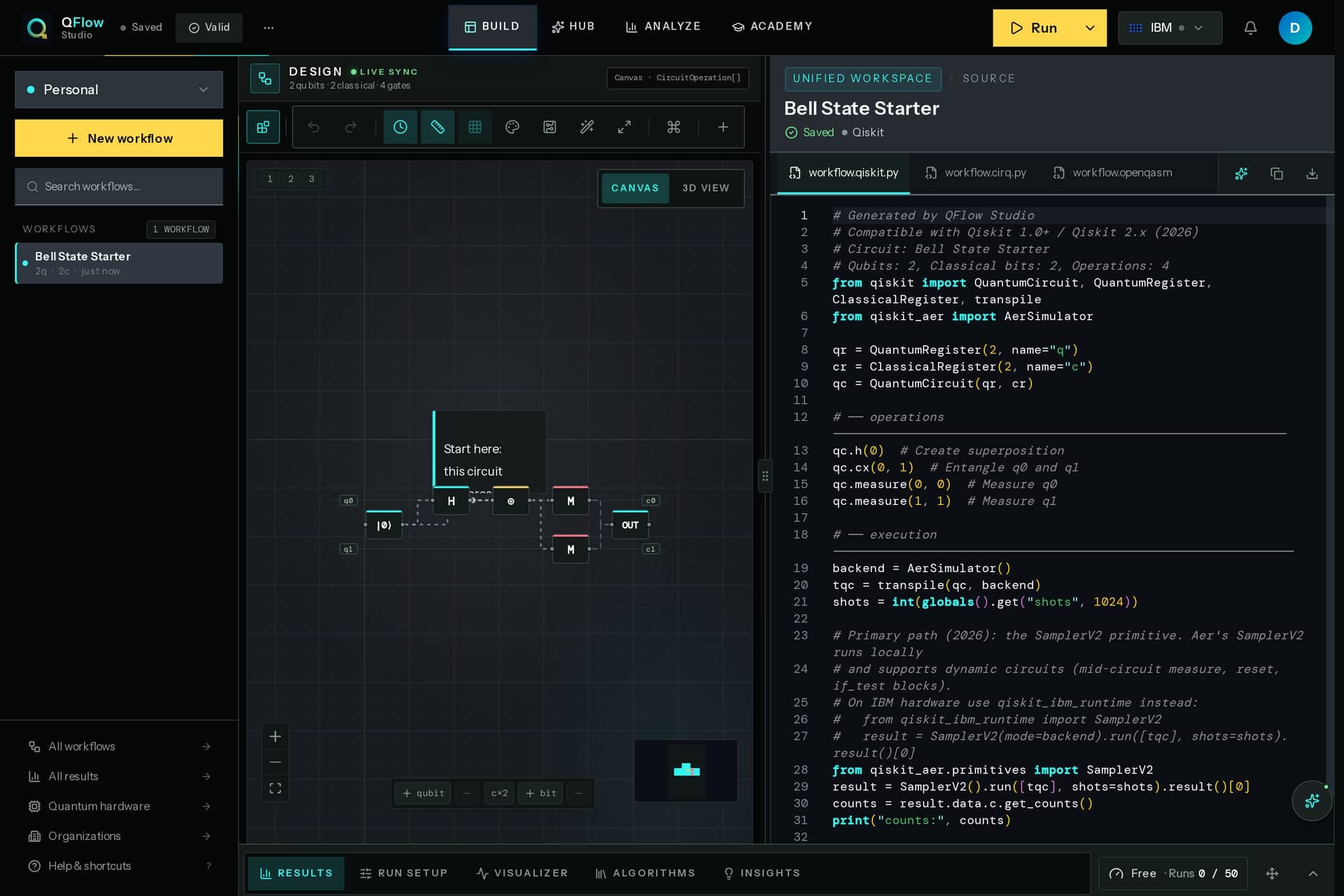
Quantum learning searches in 2026 are practical. Learners want to understand gates and circuits, but they also want to know how a circuit becomes code, how code reaches a simulator or provider, how resource estimation changes expectations, and how results become evidence. QFlow should turn learning into a workflow habit: explain, build, run, inspect, and share a reviewer-safe result.
What this covers
Students search for outcomes, not only definitionsQiskit, QDK, CUDA-Q, and OpenQASM are complementary learning signalsLearning content should produce proof
8 images
workflow2026-05-304 min read
Quantum workflow operating questions 2026: route to proof
A source-backed guide to the 2026 workflow questions teams ask when they route circuits, run hybrid jobs, estimate resources, and preserve evidence.
Quantum workflow work in 2026 is about operating questions: which source model is being tested, which provider or simulator route fits it, which hybrid loop runs where, which resource estimate changes the decision, and which evidence proves the result. QFlow should answer those questions as a route-to-proof article rather than a generic search-trend page.
What this covers
The 2026 workflow question is operationalHybrid work needs a route matrixManaged jobs and resource estimates answer different questions
8 images
workflow2026-05-266 min read
Quantum computing developments in 2026: the operating picture
Government funding, quantum-centric supercomputing, AI-assisted control, error suppression, and hybrid development are turning quantum into an operations discipline.
The biggest quantum development in 2026 is not a single machine. It is the way the field is becoming operational. Governments are funding manufacturing bottlenecks, enterprises are asking for proof, software stacks are moving toward hybrid QPU-GPU workflows, and research claims increasingly require evidence packets. Quantum is becoming a discipline of route, run, and review.
What this covers
Quantum is moving from lab calendar to operating calendarGovernment funding is targeting bottlenecksThe market is asking for proof
8 images
operations2026-05-266 min read
Highest-valued quantum computing companies in 2026
A sober look at public market caps, private valuations, SPAC pro forma values, and what those numbers actually signal for quantum buyers.
Valuation is a noisy but useful signal. Public market caps move daily, private valuations can lag reality, and SPAC pro forma values are not the same as durable enterprise value. Still, the 2026 leaderboard shows where capital believes quantum infrastructure may compound: IonQ, Quantinuum, D-Wave, PsiQuantum, Rigetti, Xanadu, Pasqal, Infleqtion, and a handful of modality specialists.
What this covers
Read the numbers with careIonQ is the public-market headlineQuantinuum and PsiQuantum lead the private valuation tier
8 images
operations2026-05-267 min read
The most important quantum computing companies in 2026
A field guide to the companies shaping hardware, cloud access, software, control systems, and quantum workflow operations this year.
The important quantum companies in 2026 are not only the ones selling QPUs. The map now includes foundries, modality specialists, cloud aggregators, SDK providers, calibration software, HPC integration, and workflow systems. A serious enterprise strategy needs to understand each layer and keep them connected through an operating record.
What this covers
IBM is the infrastructure anchorGoogle, Microsoft, AWS, and NVIDIA define the platform gravityQuantinuum, IonQ, Rigetti, and D-Wave are public-market proof points
Complete crawlable archive
Every published analysis, linked from one maintained index.
Pagination keeps the visual library manageable. This compact archive keeps every canonical article directly discoverable for readers, search engines, and retrieval tools.
- 01education · 2026-09-02QFlow begins a community test pilot with Quantum Hacettepe
- 02education · 2026-06-02Quantum learning platform workflows 2026: lessons to proof
- 03workflow · 2026-06-02Quantum circuit workflow builder 2026: visual blocks to code
- 04workflow · 2026-06-02QFlow quantum workflow software 2026: canvas to proof
- 05workflow · 2026-06-02What is quantum workflow software? 2026 operating guide
- 06hardware · 2026-06-02Quantum RF sensing for defense 2026: field-ready evidence
- 07operations · 2026-06-02Quantum telecom networks 2026: QKD, PQC, and 6G evidence
- 08education · 2026-06-02Quantum healthcare and drug discovery 2026: evidence map
- 09education · 2026-06-02Quantum biology and CRISPR workflows 2026: hype-free guide
- 10hardware · 2026-06-02Quantum AI control plane 2026: calibration, QML, and proof
- 11operations · 2026-05-30AI agents for quantum workflows 2026: calibration to proof
- 12operations · 2026-05-30Quantum pilot evidence packet questions 2026
- 13operations · 2026-05-30D-Wave quantum annealing workflow questions 2026
- 14workflow · 2026-05-30Classiq Qmod quantum workflow questions 2026
- 15hardware · 2026-05-30Quantinuum Nexus and pytket workflow questions 2026
- 16education · 2026-05-30Cirq and OpenFermion workflow questions 2026
- 17hardware · 2026-05-30CUDA-Q hybrid quantum workflow questions 2026
- 18workflow · 2026-05-30Azure Quantum resource estimation questions 2026
- 19workflow · 2026-05-30Amazon Braket Hybrid Jobs workflow questions 2026
- 20workflow · 2026-05-30Qiskit Runtime workflow questions 2026: evidence guide
- 21operations · 2026-05-30Post-quantum security migration evidence 2026
- 22hardware · 2026-05-30Dynamic quantum circuit benchmarking 2026: real workflows
- 23hardware · 2026-05-30AI for quantum calibration and control: 2026 workflow layer
- 24hardware · 2026-05-30Quantum error correction roadmap 2026: qLDPC and decoders
- 25education · 2026-05-30Quantum research categories 2026: what teams should track
- 26operations · 2026-05-30Qiskit, Braket, Azure, and CUDA-Q workflow comparison 2026
- 27education · 2026-05-30Quantum learning workflows 2026: teach with real evidence
- 28workflow · 2026-05-30Quantum workflow operating questions 2026: route to proof
- 29workflow · 2026-05-26Quantum computing developments in 2026: the operating picture
- 30operations · 2026-05-26Highest-valued quantum computing companies in 2026
- 31operations · 2026-05-26The most important quantum computing companies in 2026
- 32education · 2026-05-26Quantum computing research in 2026: the signals that matter
- 33workflow · 2026-05-26Best quantum computing products in 2026: the operating shortlist
- 34education · 2026-05-25Provider roadmaps make pilot readiness a board-level question
- 35operations · 2026-05-25Hybrid quantum teams are optimizing iteration loops
- 36hardware · 2026-05-25Hardware evidence is becoming the buyer's interface
- 37workflow · 2026-05-25Quantum-centric workflows need an operating layer, not another notebook
Editorial standard
Source material should read like a decision guide.
The blog favors primary links, maintained articles, visual evidence, and chaptered analysis over short disconnected blocks.